

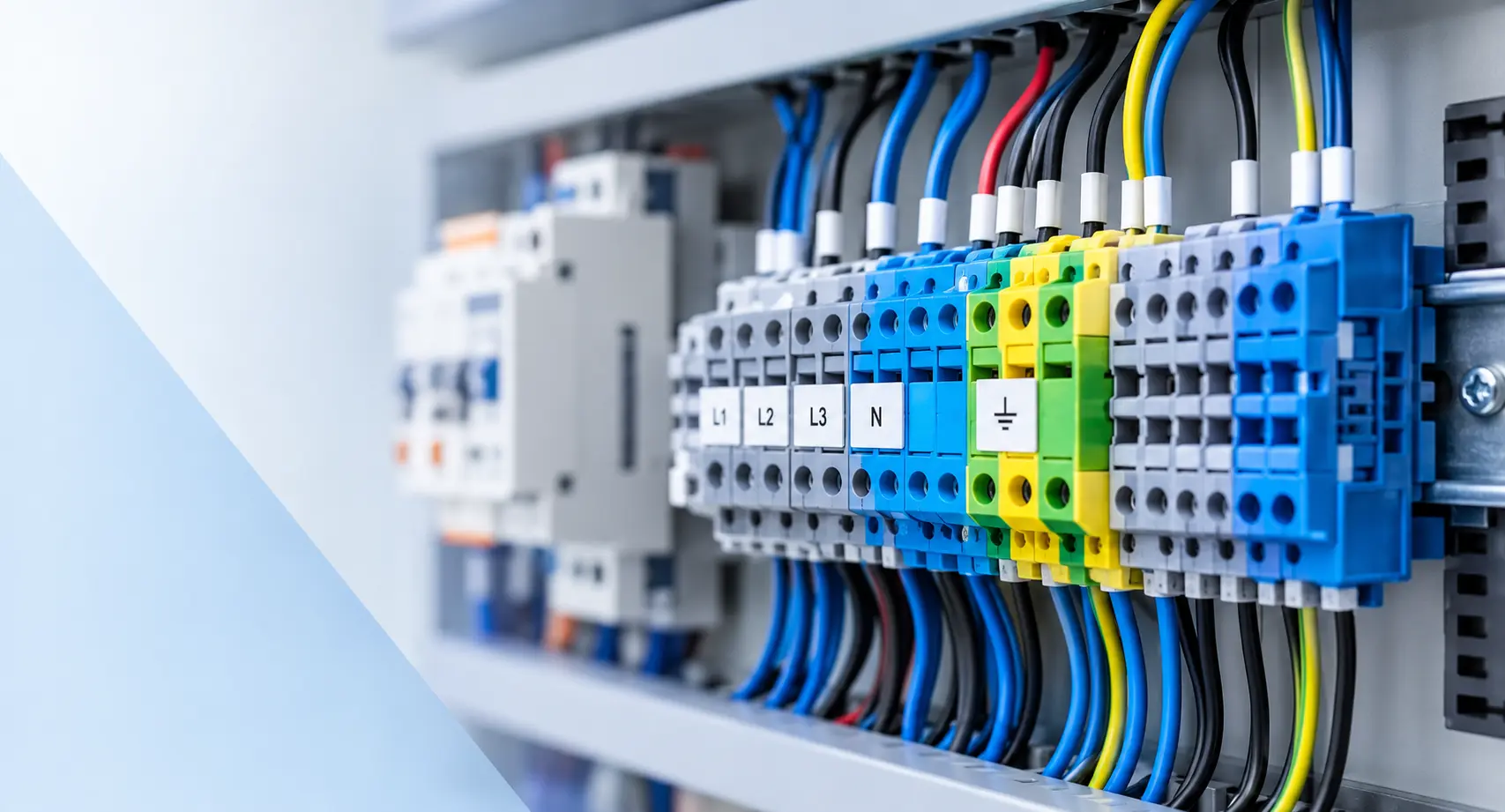
How to Select the Right Terminal Blocks for Control Panel Wiring
Terminal blocks play an important role in industrial control panel wiring by providing secure and organized connections between field devices and internal electrical components. Selecting the right terminal blocks helps improve wiring reliability, simplify maintenance, support electrical safety, and make future modifications easier. An experienced industrial automation products supplier can help identify suitable terminal blocks based on panel requirements and application needs. However, choosing a terminal block involves more than checking its size. Factors such as wire compatibility, rated voltage and current, connection type, mounting requirements, environmental conditions and applicable safety standards all influence the selection. In this guide, we explain the different types of terminal blocks, the key factors to consider when selecting them, and the best practices for reliable control panel wiring.
What Are Terminal Blocks in Control Panel Wiring?
A terminal block is an insulated electrical connector designed to join and secure conductors. In industrial control panels, terminal blocks provide connection points between external field wiring and internal components such as programmable logic controllers (PLCs), sensors, relays, contactors, drives, and power supplies. Instead of connecting every field wire directly to an internal device, panel builders can route the wiring through clearly identified terminal blocks. This arrangement makes electrical connections easier to trace, test, inspect, and maintain.
The main benefits of terminal blocks include:
- Organized wiring: Provides clearly defined connection points for incoming and outgoing conductors.
- Simplified maintenance: Helps technicians identify circuits and troubleshoot wiring problems.
- Convenient testing: Compatible disconnect and test terminals can simplify circuit testing.
- Reliable connections: Suitable terminal blocks provide secure electrical contact when installed correctly.
- Future expansion: Additional terminals and compatible accessories can simplify panel modifications.
Choosing the right terminal blocks from the beginning can improve the overall organization and serviceability of an industrial control panel.
Types of Terminal Blocks Used in Control Panels
Different terminal blocks serve different electrical and installation requirements. Understanding their functions helps panel builders select suitable components for each application.
1. Screw Terminal Blocks
Screw terminal blocks use a screw-operated clamping mechanism to secure the conductor. They are widely used in industrial control panels because they are available in different sizes and electrical ratings. These terminals are suitable for general-purpose control wiring, electrical distribution, and applications where screw connections meet the installation requirements. However, correct tightening is essential. Under-tightening can result in poor contact, while over-tightening may damage the conductor or terminal. Always follow the manufacturer’s specified torque values.
2. Spring-Clamp Terminal Blocks
Spring-clamp terminal blocks use a spring mechanism to maintain pressure on the conductor. Depending on the design, a tool may be required to open the clamp and insert the wire. They can be useful in industrial machinery and control circuits where vibration resistance and consistent clamping pressure are important. Before selecting a spring-clamp terminal, verify that it supports the required conductor size and type.
3. Push-In Terminal Blocks
Push-in terminal blocks allow compatible conductors to be inserted directly into the connection point. Many designs accept solid conductors and stranded conductors fitted with suitable ferrules. These terminals can reduce installation time, particularly in control panels containing numerous connections. They are useful for high-volume panel assembly and applications where faster wiring is beneficial. However, conductor preparation and insertion requirements vary by product, so always consult the manufacturer’s instructions.
4. Ground Terminal Blocks
Ground terminal blocks connect protective earth conductors to the panel’s protective bonding system. DIN-rail-mounted versions are designed to establish an electrical connection with a compatible conductive rail.
They help provide the required protective earthing path as part of the overall electrical safety arrangement. Use purpose-designed protective earth terminals and verify their compatibility with the DIN rail and panel earthing design.
5. Fuse Terminal Blocks
Fuse terminal blocks combine an electrical connection point with a fuse holder. They allow individual circuits to receive overcurrent protection without necessarily requiring a separate fuse holder. Some models include indicators that help technicians identify a blown fuse.
They are commonly used for control circuits, sensor supplies, and other branch circuits where individual fuse protection is appropriate. The fuse rating, voltage rating, and breaking capacity must match the application.
6. Disconnect Terminal Blocks
Disconnect terminal blocks include a mechanism that allows a circuit to be opened without removing the conductor. Depending on the design, this may involve a sliding link or knife disconnect.
They are useful in instrumentation, control signals, commissioning, and maintenance applications where circuit testing or isolation is required. Always follow the approved isolation procedure. A disconnect terminal block should not automatically be treated as a safe isolation device for every circuit.
Key Factors to Consider When Selecting Terminal Blocks
Selecting terminal blocks for control panels requires evaluating electrical, mechanical, and environmental requirements.
Wire Size and Conductor Compatibility
Start by identifying the conductor cross-section and type. Terminal blocks support specified conductor ranges, usually expressed in square millimetres (mm²) or American Wire Gauge (AWG). Check whether the terminal supports solid conductors, stranded conductors, fine-stranded conductors or ferrule-terminated wires. Using a conductor outside the approved range can result in an unreliable connection or damage to the terminal. Also, confirm how many conductors are permitted at each connection point.
Rated Voltage and Current
Every terminal block has specified electrical ratings. Select a model suitable for the circuit’s operating voltage and current, considering the manufacturer’s stated installation conditions.
The allowable current may depend on conductor size, ambient temperature, adjacent loaded terminals, and the overall installation arrangement. The wire, terminal block, and protective device must all be suitable for the intended circuit. For applications exposed to electrical transients, check the relevant insulation and impulse withstand ratings as well.
Panel Space and Mounting Requirements
Terminal blocks must fit within the available panel space while leaving enough room for wiring, identification, testing, and maintenance. Consider the available DIN rail length, terminal width, and whether single-level or multi-level terminals would suit the layout. Multi-level terminals can save space, but they must remain accessible and provide the required electrical separation. Remember to allow room for end stops, covers, separators, markers, and compatible jumpers.
Environmental Conditions
Temperature, vibration, humidity, dust, and chemical exposure can affect terminal block performance. For vibration-sensitive machinery, compare connection technologies and their manufacturer-rated suitability. For hot or corrosive environments, check the terminal’s operating temperature limits, housing material, and contact specifications.
Selecting a terminal block designed for the actual operating conditions helps reduce the risk of premature failure.
Electrical Safety and Insulation
Check the terminal block’s insulation ratings, protection against accidental contact, and applicable product approvals. Depending on the installation, relevant IEC or UL requirements may apply. Clearance and creepage distances, insulation coordination, and separation between different voltage levels must meet the applicable standards and panel design requirements. Where necessary, use suitable partition plates or separate terminal groups to maintain the required electrical separation.
Ease of Installation and Maintenance
Choose terminal blocks that technicians can install, identify, inspect, and test conveniently.
Features such as clear marking options, accessible connection points, compatible test accessories, and straightforward conductor preparation can improve productivity. Although some terminal blocks cost more initially, reduced assembly time and easier maintenance may provide long-term value.
How to Choose the Right Terminal Block for Your Application
A systematic selection process helps avoid compatibility problems and unnecessary costs.
- Identify the circuit: Determine whether the connection is used for power distribution, control signals, instrumentation, or protective earthing.
- Confirm electrical ratings: Check operating voltage, current, and relevant insulation requirements.
- Match the conductor: Verify wire size, conductor type, and ferrule requirements.
- Select the connection technology: Compare screw, spring-clamp, and push-in terminals according to the application.
- Choose the required function: Decide whether standard, ground, fuse, or disconnect terminals are needed.
- Plan the layout: Check DIN rail compatibility, wiring space, accessibility, and accessory requirements.
- Verify compliance: Review the manufacturer’s specifications and applicable standards.
- Allow for expansion: Reserve suitable space and connection capacity for expected future modifications.
For example, a control panel connecting multiple sensors to a PLC may require clearly marked feed-through terminals, while a circuit needing individual fuse protection may benefit from fuse terminal blocks. The final choice should always follow the electrical design and product specifications.
Terminal Block Materials and Accessories
Terminal block materials influence insulation, conductivity, mechanical strength, and resistance to environmental conditions.
The insulating housing is commonly made from engineering plastics, such as polyamide, selected for their electrical and mechanical properties. Current-carrying parts use suitable conductive materials, while screws and springs are designed to maintain the required conductor contact.
Common accessories include:
- End stops: Secure the terminal assembly on the DIN rail.
- End covers: Cover exposed sides where required.
- Jumpers and bridges: Connect compatible terminals for common supply distribution.
- Marker tags: Identify terminals and match them with electrical drawings.
- Partition plates: Separate terminal groups where required.
- Test plugs: Support measurements when compatible with the terminal design.
- Ferrules: Prepare suitable stranded conductors for compatible terminals.
Always verify that accessories are compatible with the selected terminal block series.
Common Mistakes to Avoid When Selecting Terminal Blocks
Avoiding common selection errors can improve control panel reliability and simplify maintenance.
- Ignoring electrical ratings: Check voltage, current, and installation conditions before selecting a terminal.
- Using incompatible wire sizes: Ensure the conductor falls within the approved range.
- Preparing wires incorrectly: Poor stripping or incorrect ferrule crimping can compromise connections.
- Choosing unsuitable terminals: Match the connection technology to the application and environment.
- Overcrowding the panel: Leave adequate room for wiring, testing, and maintenance.
- Exceeding conductor limits: Never insert more wires than the manufacturer permits.
- Using incompatible accessories: Verify that jumpers, covers, and markers fit the selected product series.
- Poor labeling: Use consistent terminal numbers that correspond to electrical drawings.
- Neglecting circuit separation: Maintain the required spacing and segregation between different circuits.
- Ignoring future requirements: Allow appropriate capacity for planned modifications.
Best Practices for Terminal Block Installation and Wiring
Correct installation is just as important as selecting the right terminal block. Following good wiring practices helps reduce connection problems and simplifies maintenance.
- Follow the manufacturer’s instructions for wire stripping, conductor preparation, and insertion.
- Use the specified tightening torque for screw terminals and an appropriate calibrated tool.
- Use compatible ferrules and the correct crimping tool where required.
- Avoid damaging conductor strands during wire preparation.
- Do not exceed the permitted number of conductors per connection point.
- Label wires and terminals consistently with the electrical schematic.
- Group power, control, instrumentation, and protective earth connections logically.
- Install compatible end stops, separators, and covers where required.
- Provide suitable cable support to prevent mechanical loads from reaching terminal connections.
- Inspect completed wiring and perform the required electrical tests before commissioning.
- Keep terminals accessible for inspection, testing, and future maintenance.
Electrical installation and testing should be carried out by suitably qualified personnel using appropriate isolation and safety procedures.
Applications of Terminal Blocks in Industrial Control Panels
Terminal blocks are used across many industrial and commercial electrical systems.
- PLC and automation panels: Provide organized connections for sensors, switches, actuators, and PLC input/output wiring.
- Motor control panels: Connect control wiring associated with contactors, motor starters, and variable frequency drives, according to circuit requirements.
- Power distribution panels: Distribute electrical supplies to multiple circuits using suitably rated terminal blocks.
- Machine control panels: Connect field devices used in packaging equipment, conveyors, assembly machines, and manufacturing systems.
- Instrumentation and process control: Organize connections for transmitters, measuring instruments, and control signals.
- Building automation and HVAC: Support control wiring for pumps, fans, dampers, and other building systems.
- Renewable energy systems: Provide connections in suitable control, monitoring, and distribution assemblies designed for the relevant electrical conditions.
Conclusion
Selecting the right terminal blocks for control panel wiring requires careful consideration of electrical ratings, conductor compatibility, connection technology, mounting requirements, environmental conditions and safety standards. Suitable terminal blocks help create organized panels that are easier to test, maintain and expand. By following manufacturer specifications and proper installation practices, panel builders can improve connection reliability and simplify long-term maintenance. For industrial automation projects, LadderlogixIndia can help you explore suitable components as an industrial automation distributor. Always verify terminal block specifications and application requirements before installation.
Read More: What Is a Safety Relay? Working Principle, Types and Applications
Frequently Asked Questions
1. What is the purpose of terminal blocks in control panels?
Terminal blocks provide organized electrical connection points between field wiring and internal components. They make wiring easier to trace, test, maintain and modify.
2. Which terminal blocks are commonly used in industrial control panels?
Common types include screw, spring-clamp, push-in, protective earth, fuse, and disconnect terminal blocks. The appropriate type depends on the electrical circuit and installation requirements.
3. How do I select the correct terminal block size?
Check the conductor cross-section, conductor type, voltage and current ratings, and manufacturer specifications. Also consider mounting space, operating conditions, and required accessories.
4. Are push-in terminal blocks better than screw terminal blocks?
Neither type is universally better. Push-in terminals can reduce wiring time, while screw terminals offer a familiar connection method. Select according to the application, conductor compatibility, ratings, and installation requirements.
5. Can two wires be connected to one terminal block?
Only if the terminal block is specifically rated for the number and type of conductors being used. Follow the manufacturer’s instructions to ensure a suitable connection.