

What Is a Safety Relay? Working Principle, Types and Applications
Industrial machines are designed to improve productivity, accuracy, and efficiency. However, when machines contain moving parts, high-speed mechanisms, or hazardous operating zones, protecting operators becomes a critical requirement. Emergency stop buttons, safety gates, light curtains, and other protective devices help reduce these risks, but they must be connected to a reliable safety control system.
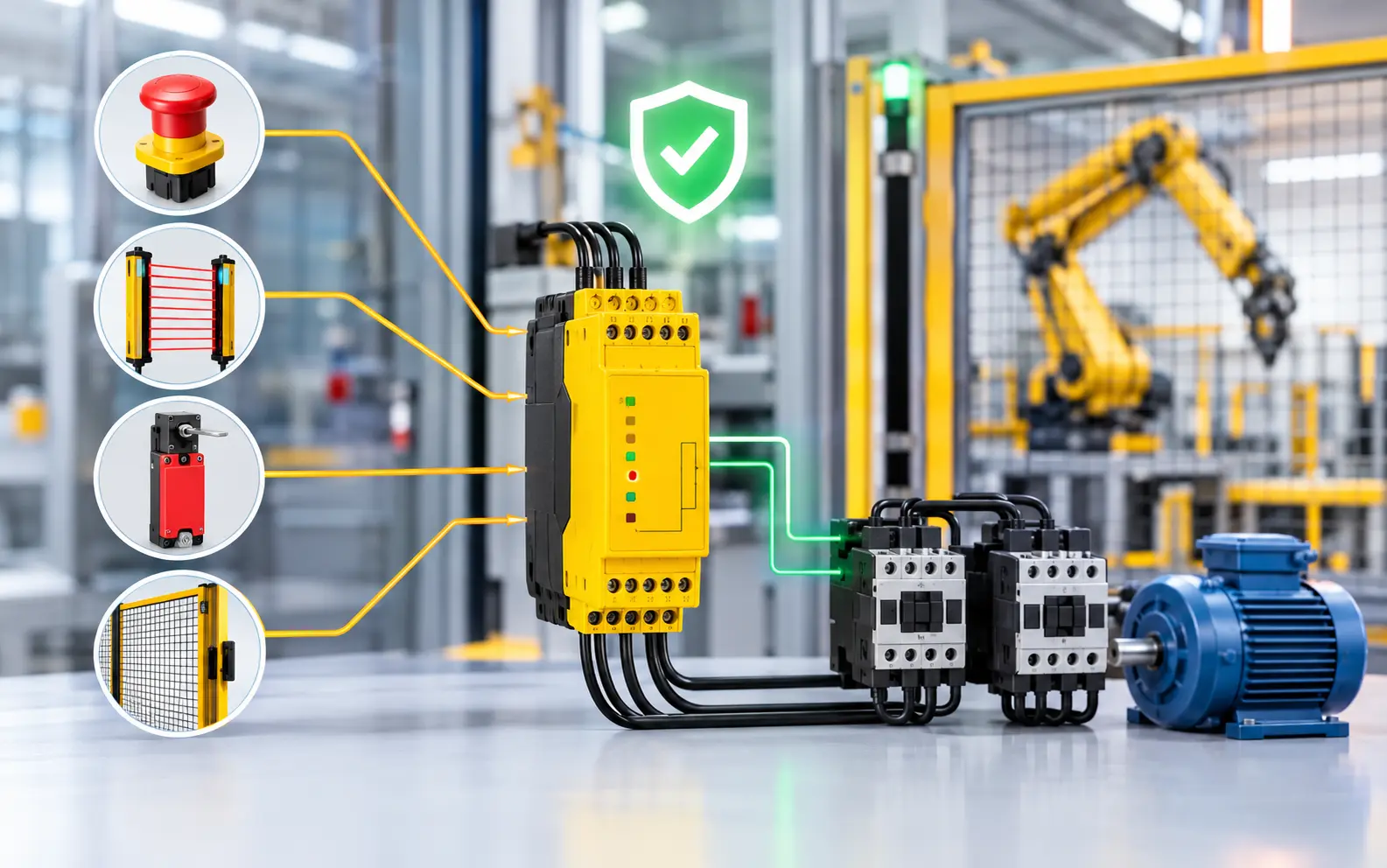
This is where a safety relay plays an important role. A safety relay monitors signals from protective devices and controls safety-related outputs to help bring hazardous machine functions to a safe state when a safety condition is violated. It is commonly used in manufacturing plants, packaging systems, robotics, conveyor lines, and industrial machinery. In this guide, we explain what a safety relay is, how it works, its different types, how it compares with a standard relay, its applications, and how to choose and maintain the right safety relay for industrial automation.
What Is a Safety Relay?
A safety relay is a safety-related control device designed to monitor protective devices and control machine functions when a hazardous condition occurs or a safety device is activated. For example, when an operator presses an emergency stop button, the safety relay processes the input signal and de-energizes its safety outputs. These outputs are connected to suitable final switching elements, such as contactors or drive safety inputs, which bring the hazardous machine function to a safe state.
Unlike a standard control relay, a safety relay is designed with specific safety features, which may include:
- Redundant circuits: Independent signal paths help reduce the risk of a single fault causing loss of the safety function.
- Fault monitoring: Depending on the model, the relay can detect certain wiring faults, channel discrepancies, or output-contact problems.
- Forcibly guided contacts: Certain electromechanical safety relays use mechanically linked contacts to support the detection of welded contacts.
- Controlled reset functions: The relay can require a deliberate reset before the machine is permitted to restart.
- Diagnostic indicators: LEDs or other indicators help technicians identify operating states and certain faults.
Safety relays are used as part of a complete machine safety system. The protection achieved depends on the relay, connected devices, wiring, final switching elements, application design, and validation of the complete safety function.
Relevant functional safety standards include ISO 13849-1, IEC 62061, and IEC 61508. The required Performance Level (PL) or Safety Integrity Level (SIL) must be determined through the appropriate risk assessment and safety design process.
How Does a Safety Relay Work?
Working Principle of a Safety Relay
The working principle of a safety relay is based on monitoring safety inputs, detecting specified faults, and controlling safety outputs. A typical dual-channel safety relay receives signals from a safety device through two input channels. It checks the input conditions and, where provided, monitors channel discrepancies, wiring faults, and feedback from external switching devices.
When the required conditions are satisfied, the relay energizes its safety outputs. These outputs allow the machine’s safety-related control system to operate. If an emergency stop is activated, a guard door opens, or a monitored light curtain detects an intrusion, the relay responds according to its configuration and de-energizes the safety outputs. The connected equipment must then stop or enter the required safe state.
Step-by-Step Working Process
Step 1: Power supply
The safety relay receives its specified supply voltage. Its internal circuitry performs the checks supported by the device.
Step 2: Safety input monitoring
The relay monitors connected safety devices, such as emergency stop buttons, guard interlocks or compatible electronic safety sensors.
Step 3: Reset and start conditions
The relay checks whether the safety inputs are in the required state and whether the configured reset conditions have been met. Some applications require a monitored manual reset.
Step 4: Safety outputs activate
When the necessary conditions are satisfied, the safety outputs energize. These outputs control suitable contactors, safety-rated drive inputs, or other elements in the machine safety circuit.
Step 5: A safety event occurs
If an emergency stop is pressed, a guard opens, or a light curtain is interrupted, the relevant input changes state.
Step 6: The machine enters a safe state
The relay de-energizes its safety outputs as required by the safety function. The connected equipment must be capable of bringing the hazardous movement or process to the intended safe state.
Step 7: Fault detection and restart prevention
If the relay detects a fault covered by its diagnostic design, it may prevent the safety outputs from re-energizing until the fault is corrected.
Step 8: Reset and restart
After the hazard has been addressed and the safety conditions restored, the system can be reset according to its design. Resetting a safety relay should not, by itself, initiate hazardous machine movement where the safety design requires a separate start command.
Key Components of a Safety Relay
The exact components vary by model, but a typical safety relay may include:
- Input terminals: Connect to emergency stop buttons, safety switches, and other protective devices.
- Safety monitoring circuitry: Evaluates the input signals and performs specified fault checks.
- Safety output contacts: Control the external elements responsible for stopping hazardous machine functions.
- Auxiliary outputs: Provide status information for monitoring or diagnostic purposes.
- Reset circuit: Supports the required reset procedure.
- External Device Monitoring (EDM): Checks feedback from external switching devices, such as contactors, when supported and correctly wired.
- Status indicators: Display power, operating status, or diagnostic information.
- Power supply terminals: Accept the voltage specified by the manufacturer.
Not every safety relay includes every feature. Always check the device’s technical documentation and wiring diagram.
Types of Safety Relays
Different safety relays are designed for different protective devices and machine safety functions.
Emergency Stop Safety Relays
Emergency stop safety relays monitor emergency stop pushbuttons and, where supported, rope-pull switches. When an emergency stop device is activated, the relay changes its safety outputs to initiate the required machine stop.
They are commonly used in production lines, machine tools, packaging equipment, and conveyor systems.
Safety Gate Monitoring Relays
Safety gate monitoring relays work with compatible guard-door interlocks and safety switches. They help prevent hazardous machine operation when a protective guard is open or when the monitored safety conditions are not satisfied.
These relays are useful in CNC machines, robotic cells, injection molding equipment, and automated assembly stations.
Light Curtain Safety Relays
Safety relays designed for compatible electronic safety outputs can monitor devices such as safety light curtains. When a person enters a protected area and interrupts the light curtain, the safety system initiates the required stop. Compatibility with OSSD (Output Signal Switching Device) outputs, diagnostic signals, and reset functions must be verified before selecting the relay.
Two-Hand Control Safety Relays
Two-hand control safety relays monitor two separate operator controls and require the appropriate simultaneous operation before allowing a hazardous machine cycle to begin.
They are used in applications such as certain presses and forming machines, where keeping the operator’s hands away from a hazardous area is part of the safety strategy.
The required timing, anti-tie-down behavior, and other functions depend on the applicable standards and equipment design.
General-Purpose Safety Monitoring Relays
Some safety relays support multiple safety functions or input-device configurations. Depending on the model, they may offer configurable reset modes, multiple safety outputs, time-delayed outputs or expansion capabilities. These devices can be useful when several protective devices must be integrated into a machine safety circuit. Their compatibility and safety ratings must be verified for the intended application.
Safety Relay vs. Standard Relay
Although safety relays and standard relays may look similar, their design purposes are different.
| Feature | Safety Relay | Standard Relay |
| Primary purpose | Safety-related machine control | General electrical switching |
| Circuit design | May use redundant safety channels | Usually designed for general control |
| Fault monitoring | Includes specified safety diagnostics | Typically lacks safety-related diagnostics |
| Contact design | May use forcibly guided contacts | Standard contacts |
| Reset behavior | Can support monitored reset and restart prevention | Depends on the surrounding control circuit |
| Safety certification | Product-specific safety ratings may be available | Not intended as a safety-rated device unless specifically designed and certified for that purpose |
| Typical applications | Emergency stops, guard monitoring, safety circuits | Lighting, ordinary control circuits, and general switching |
| Cost | Generally higher | Generally lower |
A standard relay should not be substituted for a safety relay when performing a required safety function. A conventional relay may not detect the faults or provide the diagnostic behavior required by the safety design.
Safety Relay vs. Safety Controller
A safety relay is often suitable for straightforward safety functions, while a safety controller may be better suited to more complex machines.
| Feature | Safety Relay | Safety Controller |
| Configuration | Usually fixed-function or limited configuration | Often programmable or configurable |
| Complexity | Suitable for simpler safety circuits | Suitable for more complex safety logic |
| Multiple safety devices | Depends on the model | Often supports a larger number of devices |
| Diagnostics | Basic to moderate, depending on the model | Often provides more detailed diagnostics |
| Expansion | Limited or model-dependent | May support modular expansion |
| Typical use | Individual emergency stops and guard monitoring | Complex machines, multiple zones, and coordinated safety functions |
The right choice depends on the risk assessment, number of safety functions, required safety performance, diagnostic needs, and system complexity. A safety controller is not automatically the better choice for every application.
Applications of Safety Relays in Industrial Automation
Safety relays are used in a wide range of industrial environments where people may be exposed to hazardous machine functions.
Manufacturing and Production Lines
Production lines use safety relays to monitor emergency stops, protective guards, and access points. Depending on the design, separate safety circuits can protect different machine zones.
Industrial Machines and Machine Tools
CNC machines, presses, cutting equipment, and forming machines may use safety relays to monitor protective devices and control hazardous functions.
Packaging and Assembly Systems
Packaging equipment contains moving belts, cutters, sealing mechanisms, and automated handling systems. Safety relays help integrate protective devices used during operation, loading, changeovers, and maintenance access.
Robotics and Automated Workstations
Robotic cells may use safety relays or safety controllers to monitor access doors, interlocks, and compatible area-protection devices. The complete safety system must be designed to achieve the required safe stop or other protective response.
Conveyor Systems
Conveyors may use emergency stop buttons, pull-cord switches, and guard interlocks connected to safety-related control circuits. These functions help stop hazardous conveyor movement when required.
Benefits of Using Safety Relays
When correctly selected and integrated into a suitable safety system, safety relays offer several benefits.
- Improved operator protection: Help reduce the risk associated with hazardous machine movement.
- Safety function monitoring: Monitor protective devices and respond to specified safety conditions.
- Fault detection: Certain models can detect defined wiring, channel, or contact faults.
- Clear diagnostics: Status indicators can make troubleshooting easier.
- Practical integration: Many models support common industrial protective devices and switching arrangements.
- Cost-effective design: For simpler safety applications, a safety relay can be more economical than a configurable safety controller.
- Flexible applications: Different models support different input devices, reset methods, output arrangements, and monitoring functions.
A safety relay is only one part of a machine safety system. It cannot compensate for poor machine design, incompatible components, incorrect wiring, or inadequate maintenance.
How to Choose the Right Safety Relay
Selecting a suitable safety relay requires understanding the hazard, protective devices, machine control architecture, and required safety performance.
1. Identify the Safety Function
Determine whether the relay will monitor an emergency stop, guard door, light curtain, two-hand control, or a combination of devices.
2. Conduct a Risk Assessment
Determine the required safety performance for the application. This may be expressed as a Performance Level (PL) or Safety Integrity Level (SIL), as appropriate to the design method and applicable standards. Select components and an architecture capable of achieving the required level in the complete safety function.
3. Check Input Compatibility
Confirm whether the relay supports the connected devices, including dual-channel mechanical contacts, electronic OSSD outputs or other specified signals.
4. Review Safety Outputs
Check the number and type of safety outputs and their suitability for the external contactors, valves or drive safety inputs.
5. Verify Electrical Ratings
Confirm the supply voltage, contact ratings, switching requirements, and compatibility with the intended load. Do not assume that a relay’s contact rating alone establishes its suitability for a safety application.
6. Select the Correct Reset Method
Choose the reset arrangement required by the machine safety design. Automatic reset is appropriate only where the application and risk assessment permit it. A reset should not create an unexpected machine restart.
7. Consider External Device Monitoring
Check whether feedback from contactors or other final switching elements must be monitored to identify certain faults that could prevent the machine from stopping correctly.
8. Evaluate Expansion and Diagnostics
If the machine may need additional safety devices, check whether the relay supports expansion. Also consider the diagnostic features required for maintenance and troubleshooting.
9. Check Environmental and Installation Requirements
Verify the operating temperature, enclosure requirements, mounting arrangement, terminal type, and electrical installation conditions.
10. Choose a Suitable Manufacturer and Product
Compare product documentation, safety certifications, technical support, and availability. Manufacturers such as Omron, Pilz, Schneider Electric, and Siemens offer industrial safety products, but the specific model must be verified for the intended function.
Common Safety Relay Selection and Installation Mistakes
Avoid these common mistakes when designing or maintaining safety circuits.
- Using a standard relay for a safety function: Select equipment designed and rated for the required safety application.
- Ignoring the required safety performance: Base component selection on a proper risk assessment.
- Using incompatible inputs: Verify that the relay supports the electrical outputs and diagnostic behavior of the connected safety device.
- Choosing the wrong reset arrangement: Prevent unexpected restart and follow the required safety design.
- Omitting required feedback monitoring: Ensure external switching devices are monitored where necessary.
- Ignoring electrical ratings: Confirm load compatibility and the required switching capacity.
- Using unsuitable wiring practices: Follow the manufacturer’s wiring and fault-prevention requirements.
- Overlooking future requirements: Consider additional safety devices and expansion needs during design.
- Failing to validate the installation: Test every safety function and document the results before returning the machine to service.
Never bypass a safety relay, emergency stop, guard interlock, or other protective device to keep production running.
Safety Relay Maintenance and Troubleshooting
Regular inspection and functional testing help ensure that safety systems continue to perform as intended.
Safety Relay Maintenance Tips
- Test emergency stop buttons, guard switches, and other protective devices according to the maintenance schedule.
- Inspect wiring, terminals, connectors, and enclosures for damage or deterioration.
- Check that operating conditions remain within the manufacturer’s specifications.
- Review diagnostic indicators and address faults promptly.
- Follow the manufacturer’s requirements for testing, service life, and replacement.
- Maintain records of inspections, functional tests, modifications, and failures.
- Revalidate affected safety functions after relevant changes or repairs.
Common Safety Relay Problems
- Relay does not energize: Check the supply, input channels, reset circuit, and feedback loop against the manufacturer’s troubleshooting instructions.
- Relay trips unexpectedly: Inspect the wiring, safety switches, cables, connectors, and electrical environment for possible faults.
- Relay will not reset: Check the input states, reset wiring, channel discrepancies, and the condition of monitored contactors.
- Fault indicator is active: Consult the manufacturer’s diagnostic information. Do not assume that the same LED pattern means the same fault across different models.
- Safety outputs do not de-energize as expected: Stop using the affected machine, isolate hazardous energy as appropriate, and arrange an immediate investigation by qualified personnel.
Do not attempt to repair, bypass, or return a faulty safety relay to service without the required assessment and verification of the safety system.
Conclusion
Safety relays play an important role in industrial automation by monitoring protective devices and controlling safety-related machine functions. From emergency stops and safety gates to light curtains, they help reduce risks to operators and equipment.
Choosing the right safety relay involves checking device compatibility, safety requirements, and electrical ratings. Proper installation, validation, regular inspections, and functional testing are essential for reliable operation. For new installations or machinery upgrades, Ladder Logix India, an industrial automation distributor, supports industrial automation requirements with automation components and application-oriented assistance. Always verify product specifications before integrating safety components into a machine safety system.
Read More: Omron Proximity Sensors – Types, Features, Applications & Selection Guide
Frequently Asked Questions
1. What is the main purpose of a safety relay?
A safety relay monitors protective devices and controls safety-related outputs when a hazardous condition occurs. It helps the machine enter the required safe state and may detect certain faults depending on its design.
2. How does a safety relay work?
A safety relay monitors connected safety inputs and checks the conditions required for operation. When those conditions are satisfied, it activates its safety outputs. If a monitored safety device is activated or a specified fault is detected, the outputs change state to initiate the required safety response.
3. What is the difference between a safety relay and a normal relay?
A safety relay is designed and assessed for specified safety functions and may include redundant circuits, diagnostics, and forcibly guided contacts. A standard relay is intended for general switching and should not replace a required safety-rated device.
4. Where are safety relays used?
Safety relays are commonly used in manufacturing lines, CNC machines, packaging equipment, robotic workstations, conveyor systems, and other machinery that requires monitored protective functions.
5. How do I choose the right safety relay?
Start with a risk assessment and identify the required safety function and performance level. Then check input compatibility, safety outputs, electrical ratings, reset requirements, feedback monitoring, environmental conditions, and manufacturer documentation.