

What Is a PLC? How It Works, Types, Benefits & Applications
A Programmable Logic Controller (PLC) is an industrial computer designed to monitor machines, process signals, and control automated operations in real time. PLCs are widely used in manufacturing, packaging, water treatment, automotive, and other industries where reliable and continuous machine control is essential.
From operating conveyor belts and controlling motors to coordinating robotic systems and production processes, PLCs play an important role in modern industrial automation. In this guide, we’ll explain what a PLC is, how it works, its main components and types, common programming languages, key benefits, and practical industrial applications. Whether you’re a student, technician, or engineer, this guide will help you understand the basics of PLC technology.
What Is a PLC?
A Programmable Logic Controller (PLC) is a specialized industrial computer used to control machinery and automated processes in real time. Unlike standard computers, PLCs are designed to operate reliably in demanding industrial environments, including areas with vibration, dust, temperature changes, and electrical interference.
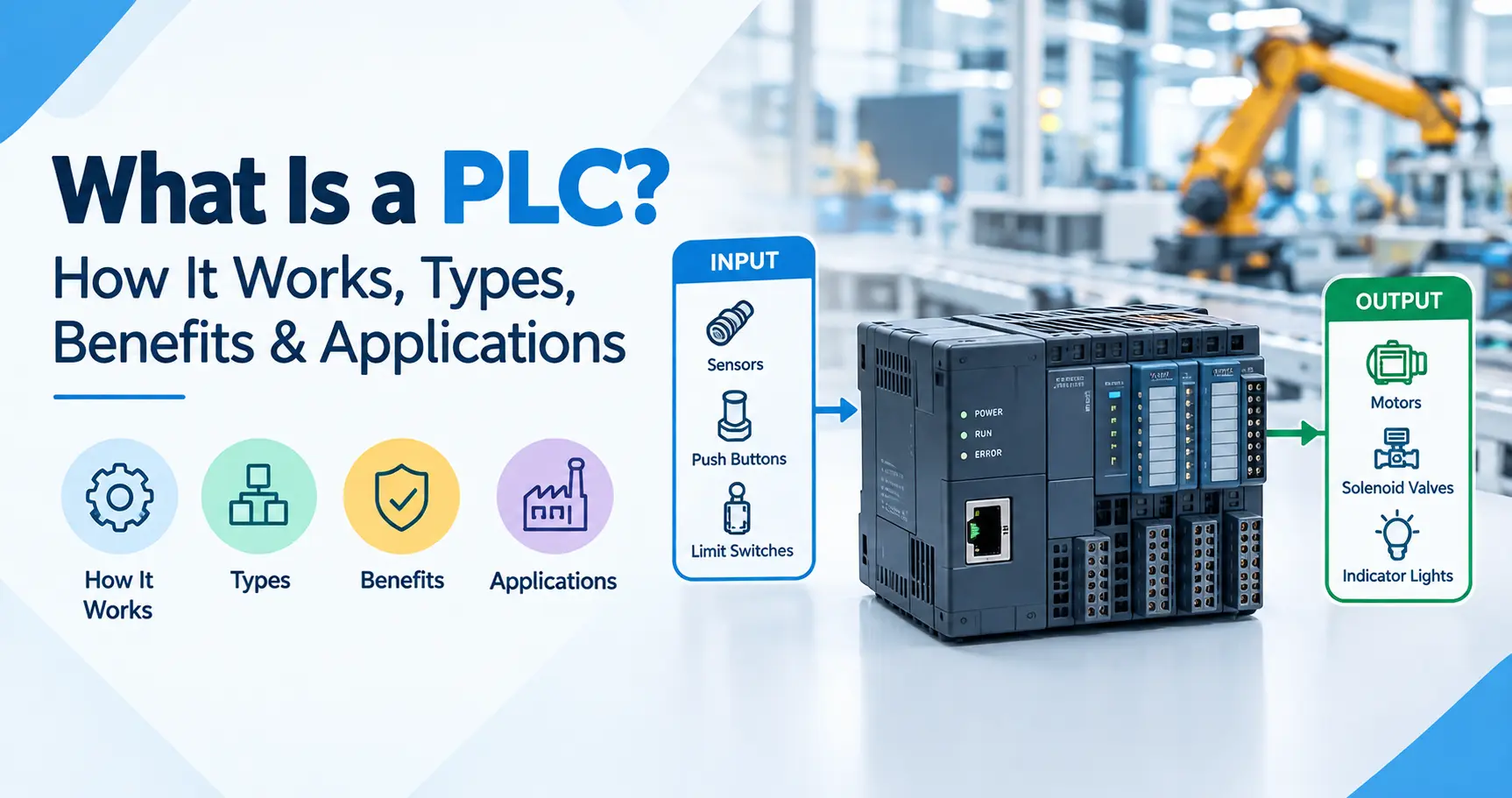
A PLC works by continuously receiving signals from input devices such as sensors, switches, and push buttons. It processes these signals according to programmed instructions and then controls output devices such as motors, valves, contactors, and indicator lights. This programmable approach replaced many traditional relay-based control systems, making industrial automation more flexible, easier to modify, and simpler to troubleshoot.
Pro Tip: A trusted PLC distributor in India can help you select the right PLC based on your application, I/O requirements, communication needs, and future expansion.
How Does a PLC Work?
A PLC works through a continuous process known as the scan cycle. During each cycle, it reads signals from connected input devices, processes them according to the programmed control logic, and updates the outputs based on the results. This process is repeated rapidly, typically within milliseconds, allowing the PLC to respond quickly to changes in an automated system.
The PLC continuously monitors the operating conditions and adjusts the connected equipment according to the programmed instructions. This enables reliable, real-time control of machinery and industrial processes, even when operating conditions change.
Main Components of a PLC
A PLC system is made up of several key hardware components that work together.
CPU (Central Processing Unit)
The CPU is the brain of the PLC. It executes the control program, processes logical and mathematical operations, and manages communication between the input/output modules and memory. The CPU also stores the program logic and handles diagnostics, such as detecting faults or communication errors.
Input/Output Modules
Input modules receive signals from field devices such as push buttons, limit switches, proximity sensors, and temperature transmitters. Output modules send control signals to actuators like motors, solenoid valves, contactors, and indicator lamps. I/O modules can be digital (on/off signals) or analog (variable signals like 4-20mA or 0-10V), depending on the type of device connected.
Power Supply
The power supply converts incoming AC voltage into the low-voltage DC power needed to run the PLC’s internal circuitry. A stable, properly rated power supply is essential, since voltage fluctuations can cause erratic PLC behavior or shutdowns.
Programming Device
This is typically a computer running PLC programming software, used to write, edit, upload, and monitor the control program. Once the program is loaded, the programming device isn’t required for the PLC to keep running, it’s mainly used for development, troubleshooting, and updates.
Communication Interface
Modern PLCs include communication ports and protocols (such as Ethernet/IP, Modbus, Profibus, or Profinet) that allow them to exchange data with other PLCs, SCADA systems, HMIs (Human-Machine Interfaces), and enterprise-level software. This connectivity is central to today’s networked, data-driven factories.
PLC Working Principle – Step-by-Step
Breaking the scan cycle down further, a PLC follows these steps repeatedly:
| PLC Step | What Happens |
| Input Scan | Reads signals from sensors and switches |
| Program Execution | CPU processes the programmed logic |
| Output Update | Sends commands to connected output devices |
| Diagnostics | Checks system status and communication |
| Repeat | Starts the next scan cycle |
This loop repeats continuously, often dozens or hundreds of times per second, ensuring the controlled process is always responding to the latest input conditions.
Types of PLCs
Not all PLCs are built the same way. The right type depends on the scale and complexity of the application.
Compact PLC
A compact PLC integrates the CPU, power supply, and a fixed number of I/O points into a single, self-contained unit. These are cost-effective and easy to install, making them ideal for small machines or simple automation tasks with limited I/O requirements.
Modular PLC
Modular PLCs consist of separate, interchangeable modules, CPU, power supply, and various I/O cards, mounted on a common rack or backplane. This design offers greater flexibility, since I/O capacity can be expanded or reconfigured as application needs grow.
Rack-Mounted PLC
Rack-mounted PLCs are a larger-scale extension of the modular concept, designed for complex industrial systems that require high I/O counts, redundancy, and extensive communication capability. They’re common in large manufacturing plants and process industries where scalability and reliability are critical.
Safety PLC
Safety PLCs are specifically designed and certified to handle safety-critical functions, such as emergency stops, machine guarding and interlocks. They meet strict safety standards (like SIL or PL ratings) and often run safety logic in parallel with standard control logic to protect personnel and equipment.
PLC Programming Languages
PLCs are programmed using standardized languages defined under the IEC 61131-3 standard. The most common ones include:
Ladder Logic
Ladder Logic is the most widely used PLC programming language, especially in North America. Its graphical format resembles electrical relay diagrams, making it intuitive for electricians and technicians transitioning from traditional relay-based control systems.
Function Block Diagram
Function Block Diagram (FBD) represents control logic as interconnected blocks, each performing a specific function (such as timers, counters, or mathematical operations). It’s particularly useful for process control applications involving continuous signal flow.
Structured Text
Structured Text (ST) is a high-level, text-based programming language similar to Pascal or C. It’s well suited for complex calculations, algorithms, and data handling tasks that are cumbersome to implement in graphical languages like Ladder Logic.
Benefits of Using PLCs in Industrial Automation
PLCs offer several advantages that have made them the backbone of modern automation:
- Reliability – Designed for continuous operation in harsh environments with minimal downtime.
- Flexibility – Reprogramming logic is far faster and cheaper than rewiring relay panels.
- Scalability – Modular designs allow systems to grow alongside production needs.
- Diagnostics – Built-in fault detection simplifies troubleshooting and reduces downtime.
- Connectivity – Easy integration with SCADA, HMI, and enterprise systems supports data-driven decision-making.
- Cost-effectiveness – Lower long-term maintenance and labor costs compared to hardwired control systems.
Common PLC Applications
PLCs are used across nearly every industry that involves automated processes.
1. Manufacturing
PLCs control assembly lines, robotic work cells, and machine tools, coordinating multiple processes to ensure consistent, high-speed production.
2. Packaging
In packaging lines, PLCs manage filling, labeling, sealing, and sorting operations, synchronizing multiple machines to maintain throughput and accuracy.
3. Automotive
The automotive industry relies heavily on PLCs for welding automation, paint shops, and robotic assembly, where precision and repeatability are essential.
4. Material Handling
Conveyor systems, automated storage and retrieval systems (AS/RS), and sorting equipment all depend on PLCs to move materials efficiently through a facility.
5. Process Control
In industries like chemical processing, food and beverage, and water treatment, PLCs regulate variables such as flow, temperature, and pressure to maintain stable, safe operations.
6. Building Automation
PLCs also extend beyond factories, managing HVAC systems, lighting control, and access systems in large commercial buildings.
PLC vs Traditional Relay Control
Before PLCs, industrial control relied on electromechanical relays wired together to perform logic functions. While effective, relay-based systems had significant drawbacks: any change in logic required physical rewiring, panels became large and complex, and troubleshooting was time-consuming.
PLCs solved these problems by replacing physical wiring with software logic. Changes that once took hours of rewiring can now be made in minutes through programming software. PLCs also offer better diagnostics, smaller footprints, and far greater reliability, making relay-based control largely obsolete for new industrial systems, though relays still play a role in specific safety or simple switching applications.
How to Choose the Right PLC
Selecting the right PLC depends on several factors:
- I/O count – How many inputs and outputs does the application require, now and in the future?
- Processing speed – Does the process demand high-speed scanning for time-critical operations?
- Communication needs – What protocols must the PLC support to integrate with existing systems?
- Environmental conditions – Will the PLC face extreme temperatures, vibration, or hazardous locations?
- Scalability – Is future expansion likely, favoring a modular over a compact design?
- Safety requirements – Does the application involve safety-critical functions requiring a certified safety PLC?
Matching these requirements to the right PLC type and brand ensures a system that’s both cost-effective and reliable for years to come.
Conclusion
PLCs continue to play a vital role in modern industrial automation, providing the reliability, flexibility, and precision needed to control machines and automated processes. Understanding PLC components, working principles, programming languages, and applications can help businesses make better decisions when planning or upgrading automation systems.
As industries move toward smarter and more connected operations through IIoT and Industry 4.0, choosing the right automation products and technical support becomes increasingly important. Ladderlogixindia, an experienced industrial automation products supplier, can help businesses find suitable automation solutions based on their application and operational requirements. With the right PLC and automation system, businesses can improve productivity, reliability and long-term performance.
Read More: Omron Proximity Sensors – Types, Features, Applications & Selection Guide
Frequently Asked Questions
1. What is a PLC and what is it used for?
A PLC (Programmable Logic Controller) is a specialized industrial computer used to control machinery and automated processes in real time. It receives signals from input devices such as sensors and switches, processes them according to programmed logic, and controls output devices such as motors, valves, and contactors.
2. How does a PLC work step by step?
A PLC works through a continuous scan cycle. It first reads signals from input devices, then executes the programmed control logic, updates the outputs, and performs diagnostics and communication tasks. This cycle repeats rapidly, allowing the PLC to respond to changes in the controlled process.
3. What are the main components of a PLC?
The main components of a PLC include the CPU, input/output (I/O) modules, power supply, programming device and communication interface. Together, these components allow the PLC to process signals, execute control programs, communicate with other systems, and operate connected machinery.
4. What are the different types of PLCs?
The main types of PLCs include compact, modular, rack-mounted, and safety PLCs. Compact PLCs are suitable for smaller machines, while modular and rack-mounted PLCs are used for larger and more expandable automation systems. Safety PLCs are designed for safety-critical applications.
5. Where are PLCs commonly used?
PLCs are commonly used in manufacturing, packaging, automotive, material handling, process control, and building automation. They can control equipment such as conveyor systems, motors, robotic cells, filling machines, HVAC systems, and automated production lines.
6. How do you choose the right PLC for an automation application?
Choosing the right PLC depends on factors such as the required number of inputs and outputs, processing speed, communication protocols, environmental conditions, scalability, and safety requirements. Considering these factors helps ensure the PLC can meet both current and future automation needs.