

- Written by: Ladder Logix
- May 30, 2026
- Categories: Ladder Logix
- Tags: , oil & gas automation solutions
Safe, Efficient, and Remote: Redefining Operations with Advanced Oil & Gas Automation Solutions
The oil and gas industry operates across some of the most logistically isolated and hazardous environments on earth. From offshore drilling platforms buffeted by ocean storms to thousands of kilometers of cross-country transport pipelines and complex downstream refining complexes, asset operators face a continuous battle to manage volatile hydrocarbons safely. Simultaneously, volatile global market pricing demands that extraction and processing facilities run at absolute efficiency, keeping operational expenditures (OPEX) minimal while extracting maximum value from every drop of crude and cubic meter of natural gas.
To thrive amid these extreme environmental and economic pressures, the modern energy sector relies heavily on sophisticated oil & gas automation solutions. By deploying distributed control architectures, fail-safe safety instruments, and intelligent remote monitoring networks, energy companies can continuously optimize production, predict equipment failures before they occur, and completely remove human operators from high-risk environments. Implementing these advanced architectures requires a deep engineering partnership with a specialized industrial automation distributor capable of handling heavy-industry complexities.
The Three Pillars of Energy Sector Automation
Oil and gas operations are conventionally broken down into three distinct segments, each presenting a specialized set of engineering and automation demands:
1. Upstream Automation: Smart Wellheads and Artificial Lift Optimization
At the extraction level, automation systems monitor downhole pressures, surface temperatures, and flow rates in real-time. Programmed controllers automatically manage artificial lift systems, such as progressive cavity pumps or gas lift injections, adjusting compression rates on the fly to maximize well depletion curves while preventing sand production or pump cavitation.
2. Midstream Automation: Pipeline Integrity and Telemetry Systems
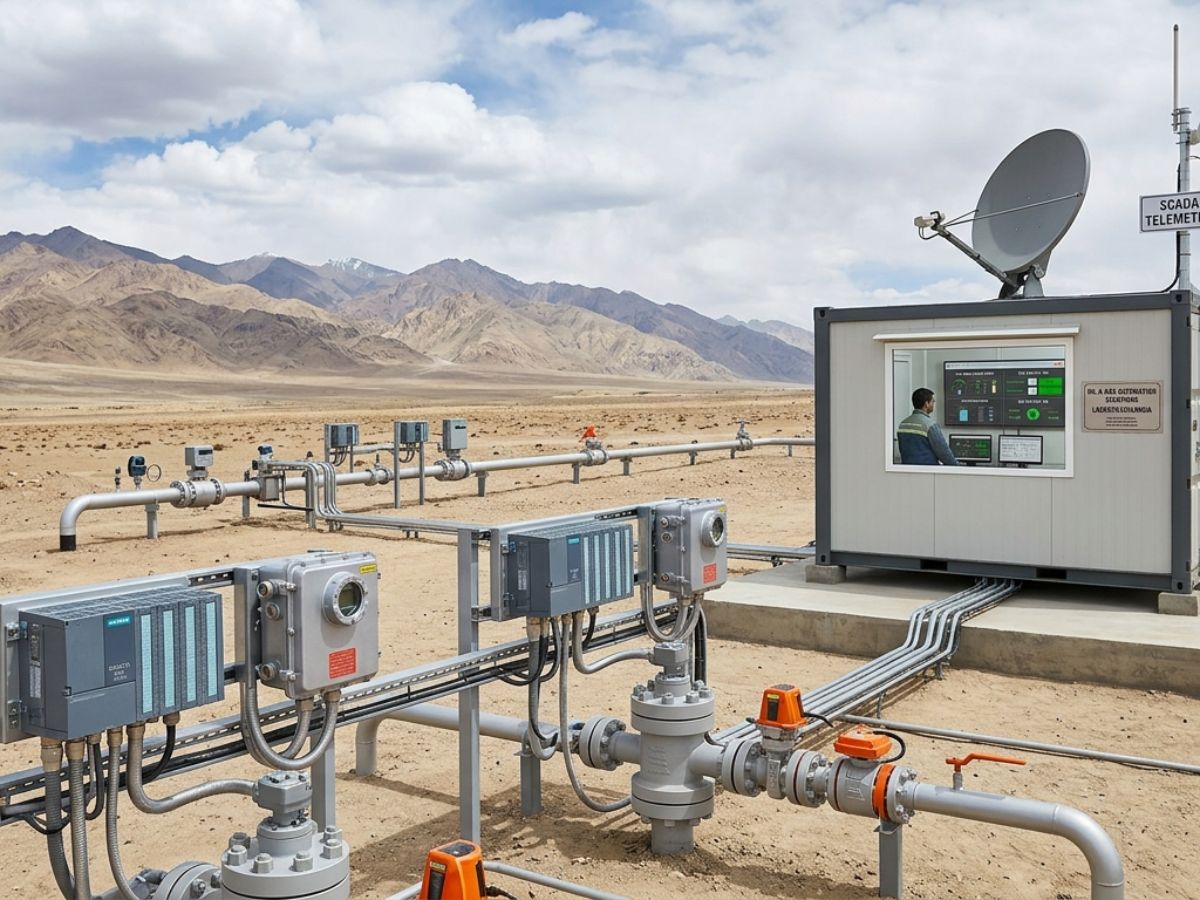
Transporting hydrocarbons across vast geographic spans requires distributed control systems. Remote Terminal Units (RTUs) and flow computers stationed along pipeline valve nodes measure custody transfer volumes, track pump station performance, and utilize advanced computational algorithms to detect minor pressure drops indicative of a pipeline leak. This data is transmitted via satellite, radio link, or cellular networks back to a centralized SCADA control room for real-time tracking.
3. Downstream Automation: Refinery Process Optimization
Inside refining and petrochemical facilities, crude oil is fractured into commercial sub-products through high-temperature distillation and catalytic cracking. This requires highly integrated Distributed Control Systems (DCS) capable of handling tens of thousands of continuous I/O loops, fine-tuning fuel-to-air ratios in process furnaces, and balancing multi-stage distillation columns to meet exacting chemical specifications.
Safety Instrumental Systems (SIS): Engineering for Zero Failures
In an industry dealing with highly combustible materials, safety cannot be treated as an afterthought it must be engineered directly into the foundational hardware layer. Automation networks in this sector are split into two completely isolated systems: the Basic Process Control System (BPCS), which manages day-to-day operations, and the Safety Instrumented System (SIS), which acts as a fail-safe shield.
The SIS utilizes highly redundant controllers (often running 2oo3 – Two-out-of-Three voting logic) and Safety Integrity Level (SIL-3) certified instrumentation. If a pressure transmitter on an oil storage tank detects a critical spike that the standard PLC fails to mitigate, the independent SIS automatically overrides the operational network, shuts down feed pumps, and activates Emergency Shutdown (ESD) valves within milliseconds to prevent a catastrophic overpressure incident.
Because a single spark can lead to catastrophic consequences, all hardware must be sourced from an authorized automation distributor to ensure strict adherence to certified explosion-proof, flameproof, or intrinsically safe designs (such as ATEX/IECEx markings).
The Evolution of SCADA and Edge Computing in Oil Operations
Traditional SCADA architectures provided clear visualization of historical data, but modern oil and gas operations demand predictive capability. By integrating edge computing devices directly at the remote wellhead or pump station, raw data can be processed locally at high speeds.
Using lightweight communication protocols like MQTT Sparkplug, edge devices stream compressed, highly structured data points back to corporate data lakes. This continuous data stream fuels predictive maintenance engines, analyzing subtle vibration variations in a multi-stage transport pump to flag bearing degradation weeks before a physical breakdown occurs. This data-driven strategy transitions operations from a costly reactive maintenance model to a highly predictable, planned interventions strategy.
Maximizing System Reliability with Industrial-Grade Infrastructure
Hardware durability dictates the ultimate success of field automation. Industrial components must operate reliably across extreme temperature ranges, from freezing sub-zero desert nights to intense noon heat, without experiencing processing lag or component failures.
By implementing heavy-duty, high-performance physical connection architectures sourced from a reputable industrial automation components supplier alongside fault-tolerant VFD control loops powered by robust Fuji Electric drives, field engineers create an incredibly resilient operational loop. Ensuring that critical connectivity components are immune to severe mechanical vibration and harsh chemical atmospheres prevents the minor network drops that frequently lead to false emergency shutdowns and costly production restarts.
Conclusion
Modernizing your oil and gas infrastructure with forward-compatible automation solutions is the most direct path to ensuring environmental safety, maintaining regulatory compliance, and driving processing margins to peak profitability. In the energy sector, operational visibility equals operational control.
Ladder Logix is an established engineering partner equipped to deliver ruggedized, scalable, and SIL-compliant oil & gas automation solutions. From building out explosion-proof field control panels and upgrading pipeline RTU networks to engineering plant-wide SCADA monitoring architectures, our team brings global expertise directly to your facility. Reach out to our heavy-industry automation consulting team today to learn how we can secure, optimize, and future-proof your extraction and refining assets.