

- Written by: Ladder Logix
- May 30, 2026
- Categories: Ladder Logix
- Tags: , automation solutions for pharmaceutical industry
Navigating Compliance and Purity: The Definitive Guide to Automation Solutions for Pharmaceutical Industry
The pharmaceutical manufacturing sector operates under a microscopic lens of regulatory scrutiny that is completely unique compared to any other industrial vertical. In an ecosystem where a minor deviation in formulation temperature, mixing speed, or ambient cleanroom pressure can compromise an entire batch of life-saving medication, there is absolutely zero margin for human error.
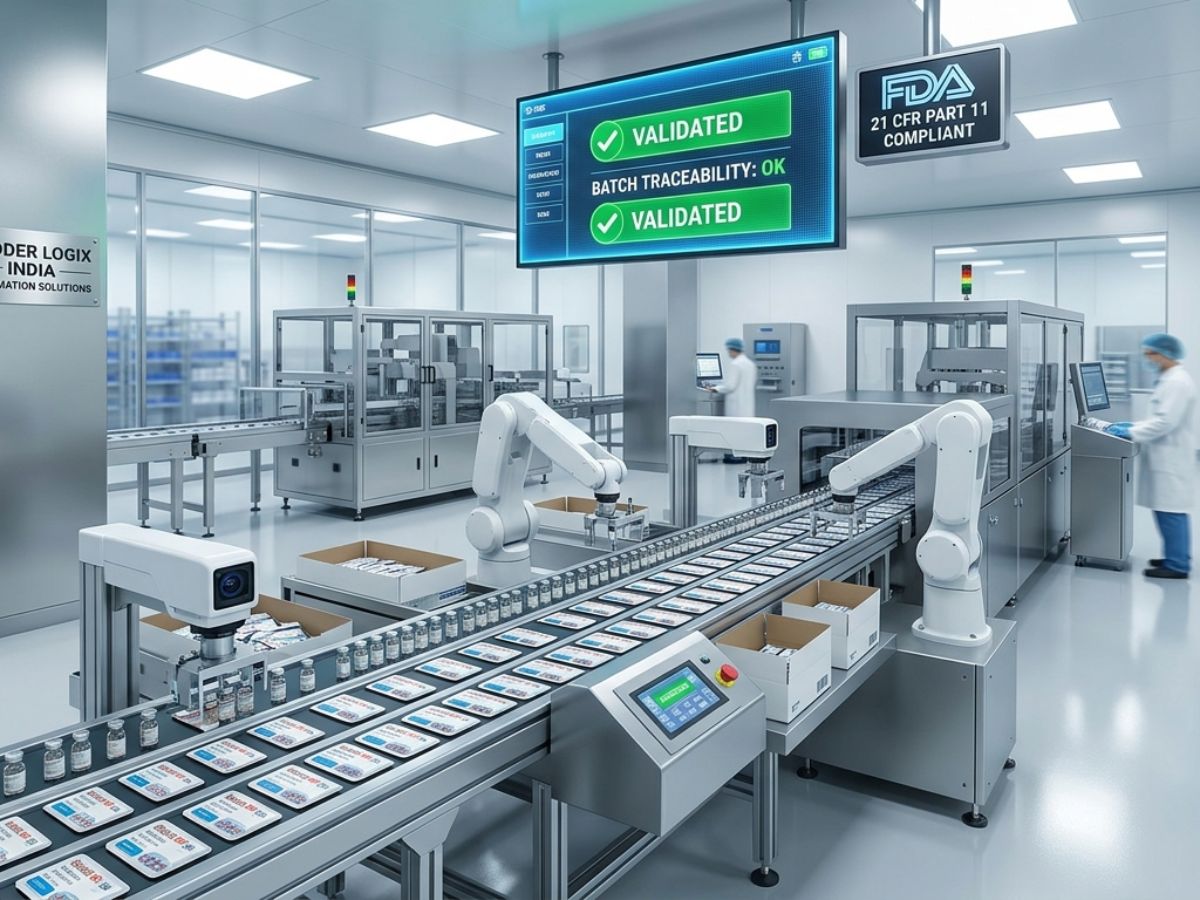
To maintain strict regulatory compliance, optimize yield, and accelerate time-to-market, global pharmaceutical companies are aggressively deploying advanced automation solutions for pharmaceutical industry applications. Far beyond simply driving high-speed packaging lines, modern automation plays a central role in guaranteeing absolute batch repeatability, establishing end-to-end product traceability, and protecting data integrity from raw material intake to final product distribution. To achieve this, plants must rely on a certified industrial automation distributor who understands the nuances of pharmaceutical validation and system consistency.
The Complex Regulatory Landscape: FDA 21 CFR Part 11 and Beyond
The core driving force behind any technology implementation in the pharma space is compliance with international guidelines, primarily set forth by the US Food and Drug Administration (FDA), the European Medicines Agency (EMA), and local regulators like the Central Drugs Standard Control Organization (CDSCO) in India.
The most critical technical hurdle for software and control systems is FDA 21 CFR Part 11, which dictates the stringent rules surrounding electronic records and electronic signatures. Any automated system controlling a pharmaceutical process must generate a secure, time-stamped audit trail that captures every single operator action, setpoint modification, and system alarm. This audit trail must be completely unalterable, automated, and easily retrievable for regulatory inspectors. Standard off-the-shelf industrial software cannot achieve this without specialized, validated engineering frameworks designed explicitly for the life sciences sector.
Key Applications of Automation in Pharmaceutical Manufacturing
1. Automated Batch Processing and Reactor Control
Active Pharmaceutical Ingredient (API) synthesis requires precise control over chemical reactions. Automated control systems utilize precision sensors and programmable logic controllers (PLCs) to modulate steam valves, cooling loops, and agitator speeds based on predefined, validated golden batch profiles. By automating these recipes, manufacturers eliminate the variability introduced by manual operations, ensuring every batch matches the exact chemical profile required.
2. Environmental Monitoring Systems (EMS) for Cleanrooms
Maintaining the sterile integrity of Class 100 (ISO 5) and Class 10,000 (ISO 7) cleanrooms requires continuous, unbroken environmental tracking. Automated EMS systems track differential pressure, relative humidity, temperature, and airborne particulate counts. If a cleanroom door remains open too long and pressure drops below the safety threshold, the automation system instantaneously triggers cascading alarms, adjusts HVAC air handling units to restore equilibrium, and logs the event for quality review.
3. High-Speed Serialization and Packaging Automation
To combat the global threat of counterfeit medications, global regulations mandate serialization the application of a unique, trackable serial number to every individual medicine carton or bottle. Automation systems combine ultra-high-speed vision systems, precision sensors, and motion control drives to verify data matrix codes, match them against global tracking databases in real-time, and automatically reject defective packaging without slowing down production throughput.
The Architecture of a Validated Pharma Automation System
Building a dependable automation system for a pharmaceutical client requires a layered hardware and software approach engineered for continuous verification.
At the field level, sterile-rated, non-reactive sensors (such as specialized Autonics temperature controllers and optical tracking sensors) monitor real-time process parameters. These parts must be sourced from a trusted industrial automation components supplier to ensure they meet stringent washdown and chemical resistance parameters.
These sensors feed data directly into high-reliability controllers, such as Omron PLCs, which run the localized execution loops. The supervisory layer consists of SCADA platforms featuring native 21 CFR Part 11 validation tools. This layer records user logins via biometric or secure badge systems, forces operators to enter specific reason codes for any parameter modifications, and interfaces directly with Manufacturing Execution Systems (MES) to compile Electronic Batch Records (EBR), eliminating the typos and missing signatures associated with traditional paper logbooks.
The GAMP 5 Framework: Ensuring Successful System Validation
Implementing technology in the pharma sector is unique because the software development lifecycle must follow the Good Automated Manufacturing Practice (GAMP 5) V-model risk-based approach.
Every automation solution deployed by Ladder Logix adheres to strict validation methodologies. This process begins with clearly defined User Requirement Specifications (URS), moves through Functional Design Specifications (FDS), and culminates in rigorous on-site execution of Installation Qualification (IQ), Operational Qualification (OQ), and Performance Qualification (PQ) protocols. This disciplined engineering ensures that when a regulatory audit occurs, the manufacturer possesses comprehensive documentation proving the system operates exactly as intended under all operating constraints.
Conclusion
Embracing comprehensive automation is no longer just a method to boost productivity it is an absolute prerequisite for maintaining market access, safeguarding consumer safety, and surviving strict regulatory audits. Transitioning away from fragmented, legacy automation setups toward unified, fully validated control systems protects your business against batch rejections and regulatory warning letters.
As a dedicated industrial automation products supplier, Ladder Logix specializes in designing, engineering, and validating turn-key automation solutions tailored specifically for the pharmaceutical and life sciences industries. Combining deep domain knowledge of regulatory frameworks with premium hardware components from global leaders like Omron, Fuji Electric, and Autonics, we deliver compliant, high-performance systems that elevate your manufacturing standards. Contact our dedicated pharmaceutical engineering division today to schedule a confidential facility assessment and begin upgrading your processing capabilities.