

- Written by: Ladder Logix
- May 29, 2026
- Categories: Ladder Logix
- Tags: , Phoenix Contact industrial connectors
Maximizing Signal Integrity in Harsh Manufacturing Environments: A Complete Guide to Phoenix Contact Industrial Connectors
In modern industrial automation, data and power transmission are the literal nervous system of the smart factory. As manufacturing setups transition to high-speed Industrial Internet of Things (IIoT) frameworks and edge computing, the demands placed on physical infrastructure have intensified. Control panels and field devices are constantly exposed to extreme mechanical stress, thermal variations, chemical washdowns, and intense electromagnetic interference (EMI). Within this chaotic environment, a single unstable connection or a compromised signal line can bring an entire production line to a catastrophic standstill.
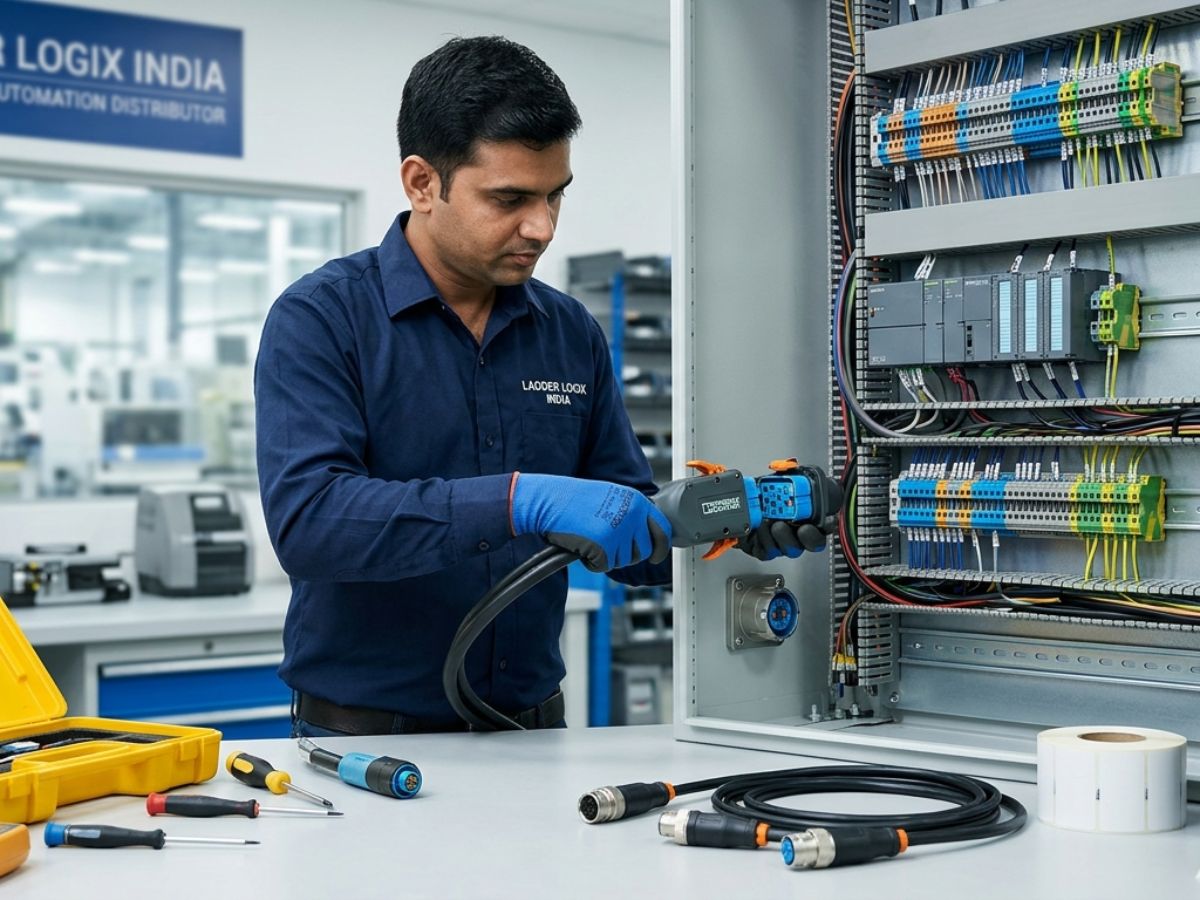
When system reliability is non-negotiable, automation engineers and industrial panel builders consistently turn to Phoenix Contact industrial connectors. Engineered to bridge the gap between heavy field-level stress and delicate, micro-precise control cabinet architecture, Phoenix Contact components provide the structural integrity required to keep data flowing seamlessly. However, sourcing these highly engineered components demands partnering with a verified authorized automation distributor who can guarantee component authenticity, provide technical application support, and maintain local stock inventory for rapid deployment.
The Challenges of Field Connection in Modern Automation
Field-level wiring presents a unique set of challenges that standard electrical components simply cannot survive. In sectors like heavy machinery manufacturing, automotive assembly, and chemical processing, connectors must withstand:
Mechanical Stress & Vibration: Constant movement from robotic arms, conveyor systems, and rotary equipment can cause terminal screws to back out or pins to lose contact over time.
Ingress of Contaminants: Fine dust, cutting fluids, lubricants, and high-pressure water jets during sanitization cycles easily breach non-industrial-grade housings.
Electromagnetic Interference (EMI): High-voltage motor drives (VFDs) and heavy switchgear generate substantial electromagnetic noise that distorts sensitive data signals moving between PLCs and field sensors.
Phoenix Contact tackles these issues head-on by engineering heavy-duty connectors and modular transmission blocks designed to isolate and protect critical connections from these exact operational stressors.
Key Categories of Phoenix Contact Industrial Connectors
To build a highly resilient automation network, it is essential to source parts from an established industrial automation components supplier who can guide you through the specific functionalities of the various Phoenix Contact connector families:
1. HEAVYCON Heavy-Duty Connectors
For applications requiring the transmission of high currents, high voltages, or mixed signals under extreme environmental duress, the HEAVYCON series sets the industry standard. These connectors feature rugged aluminum or plastic housings boasting IP65 to IP69K protection ratings. Their modular design allows power, data, and pneumatic lines to be integrated into a single, compact frame, reducing overall installation space and significantly cutting down assembly time during commissioning.
2. M8 and M12 Sensor/Actuator Connectors
As field-level sensor networks expand, M8 and M12 circular connectors have become the backbone of distributed I/O systems. Phoenix Contact offers an extensive range of shielded M12 connectors specifically tailored for high-speed Ethernet, PROFINET, and EtherCAT protocols. By incorporating advanced shielding technology directly into the connector body, these components guarantee error-free data packets even when routed parallel to high-power motor cables.
3. COMBICON PCB Connectors and Terminal Blocks
Inside the control cabinet, space optimization and fast wire termination are the primary metrics of a well-built panel. COMBICON pluggable PCB connectors provide high-density terminations with push-in spring connection technology. This allows technicians to insert ferruled wires directly without utilizing specialized tools, slashing panel-building labor costs by up to 60% while ensuring a gas-tight, vibration-resistant connection.
Engineering Benefits: Why Panel Builders Prefer Phoenix Contact
Beyond raw durability, the operational advantages of standardized Phoenix Contact architectures become evident during the long-term lifecycle of an automated facility:
Tool-Free Push-In Technology: Traditional screw-clamp terminals require periodic maintenance to check for loosening caused by thermal contraction and expansion. Phoenix Contact’s proprietary spring-cage mechanics provide a constant, uniform clamping force on the wire, ensuring maintenance-free operation for decades.
Modular Flexibility: The ability to mix and match inserts within a single heavy-duty housing means that if a machine needs to be refitted or expanded, engineers only need to swap specific internal modules rather than replacing the entire external connector infrastructure.
Global Standardization and Compliance: For machine builders exporting systems to North America, Europe, or the Middle East, Phoenix Contact connectors possess all necessary international certifications, including UL, CE, CSA, and ATEX/IECEx for hazardous areas.
Integrating Connectors with Advanced Control Cabinet Architectures
A connector does not operate in a vacuum; it must integrate flawlessly with your PLCs, HMIs, and power supplies. By utilizing Phoenix Contact connectors alongside high-end controllers like Omron or Fuji Electric drives, you construct an unshakeable operational ecosystem.
For instance, routing sensor signals from an assembly line via shielded M12 Phoenix Contact connectors into an Omron Sysmac controller guarantees that real-time operational metrics are completely accurate, devoid of the signal drops or latency common in sub-standard wiring networks. Furthermore, implementing centralized distribution blocks minimizes the congestion within wire ducts, allowing for clear labeling, easier troubleshooting, and superior airflow management to keep control cabinet temperatures within safe thresholds.
Conclusion & Call to Action
Investing in premium physical connectivity is an investment in your plant’s overall Equipment Effectiveness (OEE). While substandard connectors might offer minor short-term cost savings, the long-term expenses associated with intermittent signal faults, trace tracking, and production halts quickly eclipse the initial capital layout.
As a leading industrial automation products supplier, Ladder Logix stocks an expansive inventory of authentic Phoenix Contact industrial connectors, terminal blocks, and signal conditioning tools. Our application engineers are ready to assist you in auditing your current control panel designs, selecting the precise housing and insert configurations for your specific environment, and upgrading your systems for maximum uptime.
Contact the technical team at Ladder Logix today to request a comprehensive product catalog or a customized components quote.