

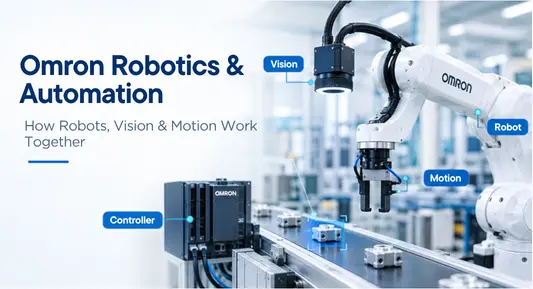
Omron Robotics & Automation – How Robots, Vision & Motion Work Together
Modern manufacturing increasingly depends on automation systems that can move products, identify parts, control precise movements and inspect results with minimal manual intervention. Robots perform physical tasks, machine vision helps systems see and identify objects, while motion control ensures accurate and synchronized movement.Omron brings these technologies together as part of its industrial automation portfolio. By combining robotics, machine vision, controllers, servo systems, safety technologies and other automation components, manufacturers can build coordinated systems for applications such as assembly, packaging, material handling, inspection and machine tending.
This guide explains what Omron robotics and automation includes, how robots, vision and motion control work together, their benefits, common applications and the key factors to consider when selecting an automation solution.
What Is Omron Robotics & Automation?
Omron Robotics & Automation refers to a range of automation technologies designed to help manufacturers automate machine and production processes. The portfolio includes industrial robots, collaborative robots, mobile robots, machine vision systems, motion control, servo systems, controllers, sensors, safety products and related automation components.
The main advantage of combining these technologies is coordinated operation. Instead of treating a robot, camera, servo system and controller as completely separate devices, an integrated automation architecture allows them to exchange information and operate as part of the same process. For example, a vision system can identify the position of a product, a controller can process that information, motion systems can coordinate the required movement, and a robot can perform the picking or assembly operation.
This type of integration can simplify programming, commissioning, diagnostics and future system expansion.
How Robots, Vision and Motion Control Work Together
A simple way to understand an automated robotic cell is to compare it with the human body:
- Robots are the hands and arms that perform physical operations.
- Vision systems are the eyes that detect, identify and inspect products.
- Motion control is the coordination system that manages accurate and synchronized movement.
- The controller acts as the brain, processing information and coordinating the different devices.
The typical sequence is:
Vision detects → Controller processes → Motion coordinates → Robot acts → Vision verifies
This coordinated approach is particularly useful when products vary in position, orientation, size or appearance.
Omron Robotics for Industrial Automation
Robots provide the physical movement required to perform repetitive and precise industrial tasks. The appropriate robot depends on factors such as payload, reach, cycle time, working environment and required flexibility.
Industrial Robots
Industrial robots are designed for high-speed, repeatable operations. Depending on the application, robot configurations such as articulated, SCARA and delta robots can be used for:
- Assembly
- Pick-and-place
- Material handling
- Machine tending
- Packaging
- Palletizing
- Component positioning
These robots are particularly suitable for applications where high throughput, repeatability and continuous operation are important.
Collaborative Robots
Collaborative robots, or cobots, are designed for applications where people and robots may work in close proximity, subject to appropriate risk assessment and safety requirements.
Cobots can be useful when manufacturers need flexible automation that can be redeployed for different tasks. Common applications include:
- Machine tending
- Light assembly
- Part handling
- Packaging
- Inspection
- Screwdriving and fastening
Their flexibility can make them suitable for low-volume or frequently changing production environments.
Mobile Robots
Mobile robots can transport materials between different areas of a factory, warehouse or production facility. Autonomous mobile robot solutions can help move components, work-in-progress materials and finished products without relying entirely on manual transportation.
This can support better material flow and reduce repetitive internal transportation tasks.
Role of Machine Vision in Robotics
A robot can perform a programmed movement very accurately, but it needs information about the workpiece when products are not always in exactly the same position.
Machine vision provides this information. A typical vision system combines cameras, lighting and image-processing software to detect, identify, measure or inspect objects.
Object Detection and Recognition
Vision systems can detect the presence of parts and identify characteristics such as:
- Shape
- Size
- Colour
- Orientation
- Position
- Product type
This allows a robot to respond to variations instead of depending entirely on fixed mechanical positioning.
Vision-Guided Robot Positioning
In a vision-guided application, the camera identifies where a product is located and provides positional information to the automation controller. The controller can then use this information to determine where the robot needs to move.
This is useful for applications such as:
- Random part picking
- Bin picking
- Assembly
- Sorting
- Packaging
- Component handling
Inspection and Quality Control
Machine vision can also inspect products during production.
For example, a vision system can check for:
- Missing components
- Incorrect orientation
- Surface defects
- Incorrect labels
- Dimensional variations
- Assembly errors
- Incorrect product placement
Detecting problems during production can help reduce waste and prevent defective products from continuing through the manufacturing process.
Motion Control in Automated Systems
Motion control determines how machines and mechanical components move. It is especially important when an application requires precise positioning, controlled acceleration, synchronization or repeated movement.
Servo Motors and Drives
Servo motors and servo drives provide controlled movement with feedback. They can regulate position, speed and torque according to application requirements.
Servo systems are commonly used in:
- Packaging machinery
- Pick-and-place systems
- Conveyors
- Filling equipment
- Labelling machines
- Cutting systems
- Precision assembly
Motion Controllers
Motion controllers coordinate the movement of one or more axes. Depending on the application, they can manage synchronized movements, electronic gearing, cam profiles and other motion functions. For example, a robot or machine may need to pick a product while that product is moving along a conveyor. Coordinating the conveyor and robotic movement requires accurate timing and motion control.
Precision Positioning
Precision positioning is essential when even a small movement error can affect product quality. Applications such as electronics assembly, dispensing, cutting, labelling and filling can require accurate and repeatable motion. Servo-based motion systems help achieve the required positioning and movement performance.
Omron Robotics, Vision & Motion Integration
The real value of robotics, vision and motion control becomes clearer when these technologies operate as one coordinated system. A typical integrated automation architecture can include: Sensors → Vision → Controller → Motion → Robot → Inspection → Feedback
Here’s how the process works:
- Sensors detect the product or machine condition.
- The vision system identifies the product, position or quality condition.
- The controller processes the information and determines the required action.
- Motion systems coordinate the required movement.
- The robot performs the physical operation.
- Vision or sensors verify the result.
- The controller responds to the feedback and continues the process.
This approach can simplify system coordination and provide better visibility into machine operation.
Key Advantages of an Integrated Architecture
- Simplified Engineering: Using compatible automation technologies can reduce the complexity of connecting separate systems.
- Shared Information: Controllers, vision systems, robots and motion components can exchange process information for coordinated operation.
- Better Synchronization: Robotic movement, conveyors and servo axes can be coordinated when timing is critical.
- Simpler Troubleshooting: Integrated diagnostics can make it easier for engineers and maintenance teams to identify problems.
- Scalability: A well-planned automation architecture can make it easier to add sensors, axes, robots or inspection functions as production requirements change.
Robots vs Vision vs Motion Control
| Technology | Primary Role | Typical Functions |
| Robotics | Physical action | Picking, assembly, handling, palletizing |
| Machine Vision | Seeing and inspecting | Detection, positioning, measurement, inspection |
| Motion Control | Precise movement | Positioning, speed, synchronization |
| Controller | System coordination | Logic, communication, sequencing and control |
| Sensors | Machine feedback | Detection, measurement and status monitoring |
Together, these technologies form the foundation of many modern robotic automation systems.
Example: How a Vision-Guided Robotic Packaging System Works
Consider a packaging line where products arrive randomly on a moving conveyor.
Step 1: Product Detection: A sensor detects products entering the robotic work area.
Step 2: Vision Inspection: A camera captures an image and determines the product’s position, orientation and other relevant characteristics.
Step 3: Controller Processing: The controller receives the vision information and tracks the product as it moves along the conveyor.
Step 4: Motion Coordination: Servo systems coordinate conveyor movement and provide the timing required for the robotic picking operation.
Step 5: Robotic Picking: A suitable robot moves to the calculated position and picks up the product.
Step 6: Placement: The robot places the product into the correct tray, carton or packaging location.
Step 7: Final Inspection: A second vision check can verify whether the product has been placed correctly.
If an error is detected, the control system can trigger an appropriate response, such as rejecting the product or stopping the process for inspection. This example shows how sensing, vision, control, motion and robotics work together rather than operating as isolated technologies.
Example: Vision-Guided Assembly
Another common application is automated assembly. A camera can identify the position and orientation of a component before the robot picks it up. The controller processes the vision data, while motion systems provide accurate positioning during the assembly operation. After assembly, vision can inspect the finished product to confirm that the component is present and correctly positioned. This combination is useful for applications where component position can vary or where automated quality inspection is required.
Key Benefits of Integrated Robotics & Automation
Higher Productivity
Automation can perform repetitive operations at a consistent pace, helping manufacturers increase production capacity.
Improved Accuracy
Vision-based positioning and controlled motion can reduce errors in handling, positioning and assembly.
Consistent Quality
Automated inspection and repeatable robotic movement can help maintain consistent production standards.
Faster Changeovers
Flexible robots and programmable automation systems can make it easier to adjust production for different products or processes.
Reduced Manual Handling
Automating repetitive material handling and production tasks allows employees to focus more on supervision, maintenance, quality and process improvement.
Better Process Visibility
Connected controllers, sensors and automation devices can provide useful production and machine information for monitoring and analysis.
Common Applications of Omron Robotics & Automation
Manufacturing
Robotics and automation can support:
- Assembly
- Machine tending
- Material handling
- Screwdriving
- Inspection
- Part positioning
Automotive
Automation can be used for component handling, assembly support, inspection, material movement and other production processes.
Packaging
Common applications include:
- Pick-and-place
- Sorting
- Labelling
- Case packing
- Palletizing
- Product inspection
Food & Beverage
Robotics and vision can support applications such as sorting, handling, portioning, packaging and inspection, with equipment selected according to the required hygiene and environmental conditions.
Electronics
Precision robotics, vision and motion control can support:
- Component handling
- Assembly
- PCB handling
- Inspection
- Testing
- Precision positioning
How to Choose the Right Robotics & Automation Solution
Choosing an automation system should begin with the production requirement rather than the individual product.
1. Define the Application
Determine:
- What task needs to be automated?
- What is the required cycle time?
- What is the product size and weight?
- What accuracy is required?
- How many products need to be processed?
2. Select the Right Robot
Robot selection depends on payload, reach, speed, accuracy, working environment and application type. High-speed production may require an industrial robot, while flexible human-robot workflows may be better suited to a collaborative solution.
3. Determine Vision Requirements
Consider whether the application needs:
- Part detection
- Position guidance
- Identification
- Measurement
- Barcode reading
- Defect inspection
Lighting and product surface characteristics should also be considered during system design.
4. Evaluate Motion Requirements
Determine the number of axes, positioning accuracy, required speed and whether multiple movements need to be synchronized.
5. Consider System Integration
Look for automation technologies that can communicate effectively and support coordinated control.
A well-integrated architecture can reduce engineering complexity and make commissioning and troubleshooting easier.
6. Plan Safety From the Beginning
Safety should be considered during the initial system design. The appropriate combination of guarding, safety devices, robot operating modes and risk-reduction measures depends on the specific application.
7. Consider Future Expansion
Think beyond the initial project. The system may later need additional inspection, robots, axes, sensors or production capabilities. Planning for scalability from the beginning can reduce future redesign work.
Future of Robotics, Vision & Motion in Smart Manufacturing
Robotics and automation are continuing to evolve as manufacturers look for greater flexibility, connectivity and production efficiency.
AI-Enhanced Vision
AI-based vision technologies can help automation systems handle more complex inspection and recognition tasks, particularly when products have greater variation.
Human-Robot Collaboration
As collaborative technologies and safety systems continue to develop, manufacturers can explore more flexible ways of combining human skills with robotic automation.
Connected Manufacturing
Industry 4.0 technologies allow machines and automation systems to generate and exchange production data. This information can support monitoring, analytics, maintenance planning and process improvement.
Flexible Production
Manufacturers increasingly need systems that can handle multiple products and frequent changeovers. Flexible robotics, vision and motion solutions can support these requirements.
Mobile Automation
Mobile robots can connect production areas with internal logistics, helping automate the movement of materials between workstations, warehouses and production lines.
Choosing the Right Industrial Automation Products Supplier
Selecting the right industrial automation products supplier is important when planning a new automation system or upgrading existing equipment. Businesses should consider product authenticity, technical support, product availability and compatibility with their application requirements. For companies looking for an authorized omron automation distributor in India, it is important to verify distributor credentials and choose a supplier that understands industrial automation requirements. The right supplier can help identify suitable automation components for robotics, machine vision, motion control, PLCs, sensors and other industrial applications.
Conclusion
Robotics, machine vision and motion control work together to improve accuracy, productivity and efficiency in industrial automation. By selecting the right technologies and integrating them effectively, manufacturers can build flexible automation systems that support consistent quality and long-term production goals. Ladder Logix India provides industrial automation products for manufacturing, packaging, machine building and other industrial applications. Businesses looking for an authorized automation distributor can explore suitable automation components and solutions to meet their operational requirements. For Omron automation products, customers should verify distributor credentials and product suitability before making a purchase.
Read More: What Is Industrial Automation? Components, Benefits & Applications
Frequently Asked Questions
Q1. What is Omron Robotics & Automation?
Ans. Omron Robotics & Automation combines robotics, machine vision, motion control, controllers, sensors and safety technologies to automate industrial processes.
Q2. How do Omron robots work with machine vision?
Ans. Machine vision identifies a product’s position, orientation or characteristics and sends this information to the control system, allowing the robot to perform accurate handling, assembly or inspection tasks.
Q3. What is the role of motion control in robotic automation?
Ans. Motion control manages the position, speed and synchronization of machine axes, helping robots, conveyors and other equipment move accurately and efficiently.
Q4. What are the benefits of integrating robots, vision and motion control?
Ans. Integration can improve productivity, positioning accuracy, quality consistency and process coordination while simplifying system monitoring, troubleshooting and future expansion.
Q5. Which industries use robotics, vision and motion control?
Ans. These technologies are commonly used in manufacturing, automotive, packaging, electronics, food and beverage, logistics and other industries requiring automated handling, inspection, assembly or precision movement.