

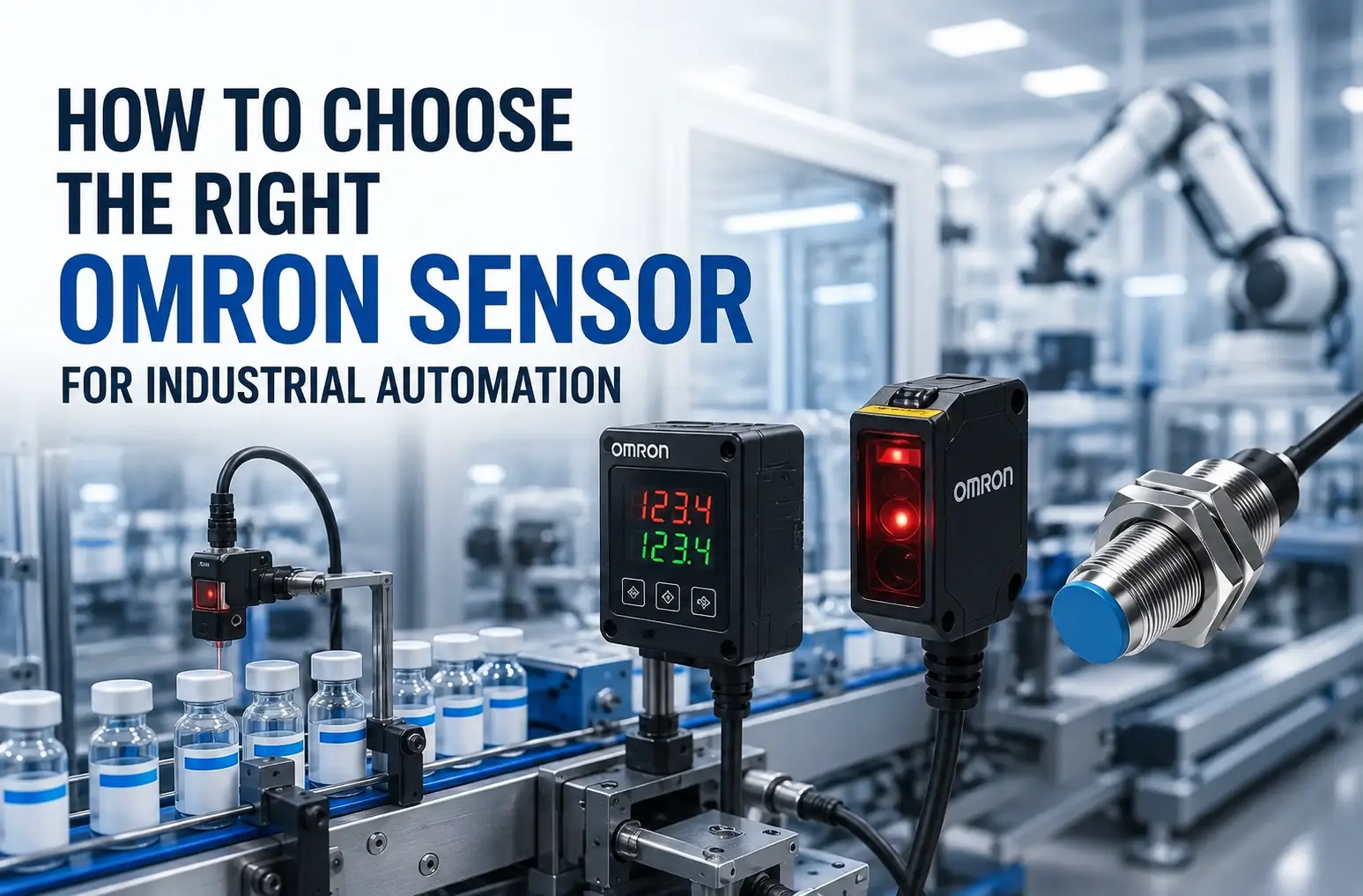
How to Choose the Right Omron Sensor for Industrial Automation
Sensors are the eyes and ears of any automated production line. They detect, measure, count, and verify, feeding the data that keeps machines running safely and efficiently. Among the many brands available today, Omron has built a reputation as one of the most trusted names in industrial sensors, offering solutions that combine precision, durability, and ease of integration. But with so many models, technologies, and specifications on offer, choosing the right Omron sensor for your specific application isn’t always straightforward. Pick the wrong one and you risk false triggers, downtime or costly rework. This guide walks you through everything you need to know, from the different types of Omron sensors to the exact criteria you should use for sensor selection, so you can make a confident, informed choice for your industrial automation setup.
What Are Omron Sensors?
Omron sensors are precision detection devices manufactured by Omron Corporation, a global leader in industrial automation. They are designed to detect the presence, absence, position, distance, color or shape of objects on a production line and to convert that physical information into an electrical signal that a PLC, controller or robot can act on.
As part of Omron’s broader sensing solutions, these devices are engineered for reliability in demanding factory environments, resisting dust, moisture, vibration, and temperature extremes while delivering consistent, repeatable readings. This makes them a preferred choice across manufacturing, packaging, automotive and process industries where even a minor sensing error can disrupt an entire line.
Types of Omron Sensors
Omron offers one of the broadest sensor portfolios in the industry. Understanding the core categories is the first step toward the right sensor selection.
1. Proximity Sensors
Proximity sensors detect the presence of an object without physical contact, typically using inductive (for metal objects) or capacitive (for non-metal objects like liquids, plastics, or powders) technology. They’re widely used for position detection, end-of-travel confirmation, and object counting in harsh, dirty or wet environments where contact-based sensing would fail.
2. Photoelectric Sensors
Photoelectric sensors use a light beam, often infrared or laser, to detect objects based on interruption or reflection of the beam. Omron’s photoelectric range includes through-beam, retro-reflective, and diffuse-reflective types, making them versatile for detecting objects of varying sizes, colors and transparency at longer distances than proximity sensors typically allow.
3. Fiber Optic Sensors
Fiber optic sensors use flexible fiber cables connected to an amplifier unit, allowing detection in extremely tight or hard-to-reach spaces where a standard sensor housing simply won’t fit. They’re a go-to solution for small-parts detection in compact machinery and confined mounting locations.
4. Displacement/Measurement Sensors
These sensors measure distance, thickness, height, or displacement with high precision, often using laser or confocal technology. They’re essential in quality control applications where dimensional accuracy directly affects product conformity, such as measuring sheet thickness or verifying component height.
5. Encoders
Encoders convert mechanical motion, rotary or linear, into electrical signals that indicate position, speed or direction. They play a critical role in motion control systems, robotics and servo-driven applications where precise feedback is non-negotiable.
6. Vision Sensors
Vision sensors capture and analyze images to perform tasks like defect detection, character recognition, presence verification and shape/color matching. They bring a layer of intelligence beyond simple detection, making them ideal for complex quality inspection tasks that traditional sensors can’t handle.
7. Other Relevant Sensing Technologies
Beyond the core categories, Omron’s sensing solutions also include pressure sensors, temperature sensors, flow sensors and safety sensors (such as light curtains and safety laser scanners), rounding out a complete ecosystem for industrial monitoring and protection.
Pro Tip: Choose omron distributors in India offering genuine products, technical support, availability and reliable after-sales service.
How Omron Sensors Work
At a fundamental level, every Omron sensor follows the same basic principle, it detects a physical change (light, magnetic field, capacitance, distance, or image) and converts that change into an electrical output signal. This signal is then transmitted to a PLC, controller or HMI, which interprets it and triggers the appropriate automated response, stopping a conveyor, rejecting a defective part, counting units or adjusting a robotic arm’s position.
The underlying detection method varies by sensor type, inductive proximity sensors generate an electromagnetic field and detect disruptions caused by metal objects; photoelectric sensors emit and receive light beams; vision sensors use cameras and image-processing algorithms and encoders track mechanical rotation or linear movement using optical or magnetic patterns. Despite these different mechanisms, Omron engineers each sensor for fast response times, high signal stability and resistance to industrial noise and interference.
How to Choose the Right Omron Sensor
Selecting the correct sensor comes down to matching its specifications to your exact application requirements. Here are the key factors to evaluate:
1. Detection Object
Start by identifying what you need to detect, metal, plastic, liquid, glass, powder or a specific color or shape. The nature of the object determines which sensing technology (inductive, capacitive, photoelectric or vision) will work reliably.
2. Detection Distance
Consider the distance between the sensor and the target object. Proximity sensors typically work at shorter ranges, while photoelectric and laser-based sensors can detect objects several meters away. Always allow a safety margin rather than choosing a sensor at the very edge of its rated range.
3. Material
The material composition of both the target object and its surroundings affects sensor choice. Reflective, transparent or dark-colored materials, for instance, can affect photoelectric sensor performance, while non-metallic materials require capacitive rather than inductive proximity sensors.
4. Environment
Factory conditions vary widely, dust, humidity, temperature extremes, washdown requirements, vibration and electromagnetic interference can all affect sensor performance. Check the sensor’s IP rating, operating temperature range and housing material against your actual plant-floor conditions.
5. Accuracy
Applications like quality inspection or dimensional measurement demand high-precision sensors, while simple presence/absence detection may not need the same level of accuracy. Match the sensor’s resolution and repeatability specs to how critical precision is for your process.
6. Response Time
For high-speed production lines, the sensor’s response time (how quickly it can detect and signal a change) becomes critical. A sensor that’s too slow for your line speed will miss objects or introduce timing errors downstream.
7. Mounting
Space constraints on your machine or line will influence sensor housing size and shape. Fiber optic sensors, for example, are often chosen specifically because their compact amplifier and flexible fiber head allow mounting in locations a standard sensor body cannot reach.
8. Output Type
Finally, confirm the sensor’s output type, NPN, PNP, analog, digital or communication protocol (such as IO-Link), matches your PLC or controller’s input requirements. A mismatch here can mean additional wiring, converters or complete incompatibility.
Omron Sensor Applications
Omron sensors are deployed across nearly every manufacturing sector. Here’s how they’re commonly applied:
- Packaging: In packaging lines, sensors detect product presence, count items, verify label placement and confirm correct packaging seal, keeping high-speed lines running without jams or mispacks.
- Automotive: Automotive manufacturing relies on sensors for precise component positioning, weld verification, robotic guidance and safety monitoring around automated assembly cells.
- Pharmaceutical: In pharma production, sensors ensure accurate fill levels, verify blister pack completeness and support strict quality and traceability requirements demanded by regulatory standards.
- Food Processing: Food processing lines use hygienic, washdown-rated sensors to detect product presence, portion sizes, and packaging integrity, all while withstanding frequent cleaning cycles.
- Textile: In textile manufacturing, sensors monitor thread breakage, fabric edge position, and roll thickness, helping maintain consistent quality across long production runs.
- Material Handling: Conveyor systems, sorting stations and automated storage/retrieval systems use sensors extensively for object detection, positioning and collision avoidance.
Common Problems When Selecting Industrial Sensors
Even experienced engineers run into selection pitfalls. Some of the most common issues include:
- Ignoring environmental conditions, leading to premature sensor failure in dusty, wet, or high-temperature areas
- Underestimating detection range or object size, resulting in inconsistent or missed detections
- Overlooking output compatibility, causing wiring and integration headaches during installation
- Choosing based on price alone, without considering long-term reliability and total cost of ownership
- Not accounting for future scalability, forcing a full sensor replacement when production needs change
- Skipping a site assessment, relying only on datasheets instead of real-world testing on the actual line
Working with an experienced automation partner during the sensor selection process helps avoid these costly mistakes.
Pro Tip: An authorized omron automation distributor in india can help you source genuine products with the right technical guidance and dependable support.
Benefits of Using the Right Omron Sensor
Choosing the correct Omron sensor for your application delivers measurable benefits:
- Improved process reliability with fewer false triggers or missed detections
- Reduced downtime thanks to durable, industrial-grade construction
- Higher product quality through accurate, repeatable measurements
- Lower total cost of ownership, since the right sensor lasts longer and needs less maintenance
- Easier system integration, with compatible outputs and communication protocols
- Scalability, as Omron’s sensing solutions are built to grow with evolving automation needs
How Ladder Logix India Can Help
Selecting the right sensor isn’t just about reading a datasheet, it’s about understanding your process, environment, and long-term automation goals. That’s where Ladder Logix India comes in. As a trusted automation solutions provider, Ladder Logix India helps manufacturers assess their specific requirements and recommends the right Omron sensor for the job, whether that’s a proximity sensor for a harsh foundry environment or a vision sensor for a high-precision inspection line. The team offers end-to-end support, from sensor selection and system integration to installation and after-sales technical assistance, ensuring your automation investment performs reliably from day one.
To explore Omron’s full range of sensing solutions and get expert guidance tailored to your application, visit Ladder Logix India.
Conclusion
Choosing the right Omron sensor for industrial automation comes down to understanding your application inside and out, the object being detected, the environment it operates in, the precision required and how the sensor will integrate with your existing systems. With Omron’s extensive range of industrial sensors, there’s a solution for nearly every automation challenge, but getting the selection right requires careful evaluation rather than guesswork.
Partnering with an experienced automation specialist like Ladder Logix India can simplify this process considerably, helping you avoid costly mistakes and get a sensing solution that performs reliably for years to come.
Read More: Omron PLC & HMI Supplier in India – Trusted Industrial Automation Partner
FAQs
1. What is the difference between an inductive and a capacitive proximity sensor?
Inductive proximity sensors detect only metal objects using an electromagnetic field, while capacitive proximity sensors can detect metals, liquids, plastics, and powders by sensing changes in capacitance.
2. How do I know which Omron photoelectric sensor to choose?
It depends on your detection distance, object type, and environment. Through-beam sensors offer the longest range and highest reliability, retro-reflective sensors are easier to install, and diffuse sensors are best for shorter-range, single-side mounting.
3. Can Omron sensors be used in washdown or hygienic environments?
Yes, Omron offers sensors with appropriate IP ratings and food-grade housings suitable for washdown environments common in food processing and pharmaceutical applications.
4. What output types do Omron sensors support?
Omron sensors are available with NPN, PNP, analog, digital and IO-Link outputs, allowing flexible integration with a wide range of PLCs and controllers.
5. Why should I choose Omron over a generic industrial sensor?
Omron sensors offer higher build quality, consistent performance, better environmental resistance and stronger long-term reliability, reducing downtime and total cost of ownership compared to generic alternatives.